


Beef Magnifique!
Watch the YouTube video! Once upon a time - long


Watch the YouTube video!
Once upon a time - long before the advent of modern civilization, in the heart of France’s Limousin region - there lived a tribe of people who were gifted in capturing the beauty of nature in their rock engravings. Deep in the caves of Lasceaux, these tribesmen paid homage to the majestic beasts that roamed their lands and provided food for their families, stunningly capturing their sturdy bodies, alert eyes, and proud stance in a carefully carved image of hard rock. Fast forward 20,000 years, and an extraordinary discovery was made; the beasts engraved in the caves of Lasceaux in France remarkably resembled the present-day Limousin cattle - a testament to the history and importance of the breed as we know it today. At present, the modern Limousin can be found in more than 70 countries worldwide, including South Africa.
In the year 1974, the first Limousin cattle set foot on the soil of South Africa.
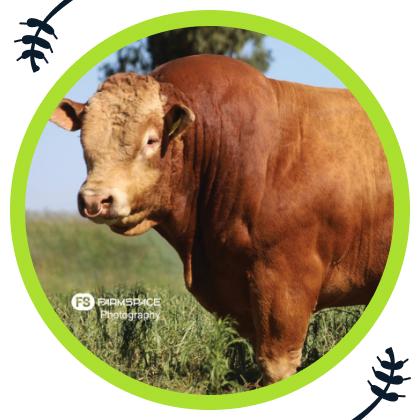
From those early depictions, the breed has evolved and adapted to changing environments through breeding and selection, but it has always maintained its characteristic traits of strength, efficiency, and adaptability. The region of their origin was known for its acidic, weakly mineralised granite and large variations in temperature, leading to the development of a hardy breed with an unusually thin but solid bone. Although an average-sized animal, its eyes sparkled with life, and its body was well-moulded, a testament to its hardiness that did not go unnoticed by the people of the Limousin region, who soon realized the worth of these golden red cattle with their unique characteristics. It was because of this that the Limousin Herd book was created in 1886, sending a message of uniformity to breeders all across the land.
By 1914, over 5000 Limousin cattle had already been registered in France and as time passed, breeders began to crossbreed the Limousin with the Agenais – resulting in the production of high-quality beef cattle that would later become a prized breed all across the world. In the year 1974, the first Limousin cattle set foot on the soil of South Africa. The popularity of these sturdy creatures – with their beautiful red coats, bright eyes and strong physique - has grown immensely since they were first imported to South Africa 1974.
Nearly 10 years later, in 1986, the Limousin Cattle Breeders’ Society of South Africa was established, giving the breeders a platform to come together and share their knowledge and love for these creatures with one another. Since then, the society grew stronger and more independent, with the number of breeders having grown from a mere 7 to over 100 today. During this time and with each passing year, more and more Limousin cattle were imported, and their numbers swelled to over 11,000 registered cattle. In 1996, the Limousin Cattle Breeders’ Society of South Africa became an entity that operated independently, owning its own office in Bloemfontein and operating the Breed-plan performance recording system.
The reason for this enormous growth in numbers and interest in the breed was due to its exceedingly impressive abilities, in spite of the harsh conditions of the African continent. The Limousin breed boasts a reputation for its effortless calving, producing robust and well-adapted calves that thrive in the harsh conditions of the highveld with its unpalatable sourveld grasses and cold winters, as well as its longevity – the exact traits that commercial breeders need to succeed in the industry. On a genetics level, the Limousin has what is known as the “myostatin gene mutation”. They possess 2 copies of the F94L gene that results in a non-double muscling phenotype with an increased muscle fibre count.

These cattle are also prized for their remarkable feed conversion, average daily gains, and ability to produce top-quality lean beef, making them extremely desirable to feedlots.
They boast with some of the most efficient and profitable carcass traits of any breed found in South Africa, with high slaughter percentages, meat yields, and meat-to-bone ratios, and minimal excess fat wastage - something that retailers highly value.
The significance of this is a carcass with a greater percentage of high-value cuts, a greater percentage of retail cuts, minimal excess fat wastage, and meat that Is both tender and delicious – all natural without the need of growth promoting hormones. Additionally, Limousin meat has exceptional marbling whilst still being low in saturated fats and cholesterol, all qualities that currently drive the consumer market. The Limousin breed is perfectly positioned to cater to the needs of the South African beef market, providing exactly what the consumers want, what the retailers need, what the feedlots desire, and what the commercial breeders are looking for.
The Limousin cattle breed has proven itself to be versatile, efficient, and profitable, exceptionally well-suited to the needs of the South African beef market. And the best part…there is no need to travel across the world all the way to France to get your hands on these magnificent animals. Limousin breeders can be found in any of the 9 provinces across South Africa, hard at work creating the perfect solution for South Africa’s beef market.


