


CNH Beach Care Project Lands in South Africa:
8 min read|
⏳ 7-8 min - Estimated read time Watch the video

Watch the video here!
Inspiring a New Wave of Young Ocean Guardians
When 150 excited school children arrived on Strand Main Beach on a bright December morning, few realised they were taking part in the beginning of a movement—one that blends education, environmental stewardship, and community action into a single, powerful force. The launch of the CNH Beach Care Project in South Africa was far more than a symbolic gesture; it represented the expansion of a global initiative already changing coastlines and communities across seven countries.
Armed with gloves, bags, curiosity, and a willingness to learn, the children of Hendrik Louw Primary School and the youth supported by DSSK (Die Straat Se Kind) stepped onto the sand not only to clean—but to understand. And that is precisely the mission of the Beach Care Project: to inspire the next generation of ocean guardians through practical action, education, and long-term awareness.

A Global Initiative Anchored in Local Heart
Since 2020, CNH has been rolling out the Beach Care Project across the world, using a simple but powerful formula: teach, demonstrate, clean, and empower.
By launching the programme in South Africa, CNH and its brand CASE Construction Equipment signalled not only an environmental commitment but a social commitment. South Africa’s coastline is both a national treasure and a vulnerable ecosystem under increasing pressure. Plastic pollution, habitat degradation, extreme weather, and urbanisation all weigh heavily on the country’s shores.
For Johan Joubert, General Manager of CNH Construction Segment South Africa, the project holds deep local relevance:
“South Africa’s coastline is one of our greatest natural treasures. Bringing the CNH Beach Care Project here is a proud moment for us. Seeing young people take the lead today gives me great confidence in the future of our oceans.”
But the project’s strength does not come from machinery or brands alone. It is built on partnerships with trusted South African organisations who have spent years protecting, educating, and advocating for marine ecosystems.
Education First: Turning Awareness into Action
One of the core pillars of the Beach Care Project is education. Children and volunteers participated in a series of hands-on learning experiences designed to connect them emotionally and intellectually with the ocean.

Marine Science Made Real
The Two Oceans Aquarium Foundation, a leader in ocean education, brought its expertise straight to the shoreline. Through interactive sessions, students learned:
- Why marine ecosystems matter
- How different species—from turtles to tiny crustaceans—depend on healthy oceans
- How microplastics infiltrate the food chain and ultimately affect human health
These were not abstract lessons. Children held samples of microplastics, examined ocean artefacts, and learned how even the smallest piece of litter has a measurable impact on marine wildlife.
Water Safety Saves Lives
The National Sea Rescue Institute (NSRI) added a vital layer to the programme: water safety. As drowning remains a critical challenge in coastal communities, the NSRI’s guidance was more than informative—it was lifesaving.
Their team demonstrated:
- How to identify dangerous currents
- What to do when someone is in distress
- Why safety equipment and signage are essential
- How community awareness drastically reduces drowning incidents
In a country where many youth grow up near water but without formal swimming or safety training, these skills may one day save lives.
Caring for the Coastline Starts at Home
Local grassroots organisation HOAM – Helderberg Ocean Awareness Movement brought passion and perspective from years of daily beach cleanups along the Helderberg coastline. Founder Lisa Starr reminded the children that caring for the ocean starts with understanding and appreciating it:
“Only when you understand and connect with nature will you fall in love with it. Only then will you protect and fight for what you love.”
Her message resonated deeply. By placing environmental responsibility directly in the hands of the youth, HOAM helped the children see themselves as part of a larger ecological story.
The Power of Community: Lifting Children Beyond the Beach
The participation of DSSK (Die Straat Se Kind) was a moving testament to how environmental action can uplift vulnerable communities. DSSK supports young people in Grabouw with daily nutrition, academic guidance, and a safe developmental space. Many of the children who participated in the Beach Care Project had never been part of an organised coastal conservation activity.
For DSSK founders Chenelle and Junon Franke, the project offered more than environmental education—it offered belonging and hope.
DSSK’s ongoing mission includes:
- Food security programmes
- After-school learning support
- Recreational and developmental initiatives
- Community upliftment and family outreach
By bringing their young leaders to Strand, DSSK reinforced the values of responsibility, opportunity, and community pride.

Hands in the Sand: Where Learning Meets Impact
After a morning of learning, the students, volunteers, and partner organisations moved to the beach for the cleanup itself. Bags filled quickly with:
- Plastic bottles and caps
- Food wrappers
- Fishing line
- Cigarette butts
- Microplastics
- Stray packaging and polystyrene
Tons of waste are washed onto South Africa’s beaches each year. For many of the children, it was an eye-opening experience to physically collect what they previously assumed “just disappears.”
Machines Doing Their Part
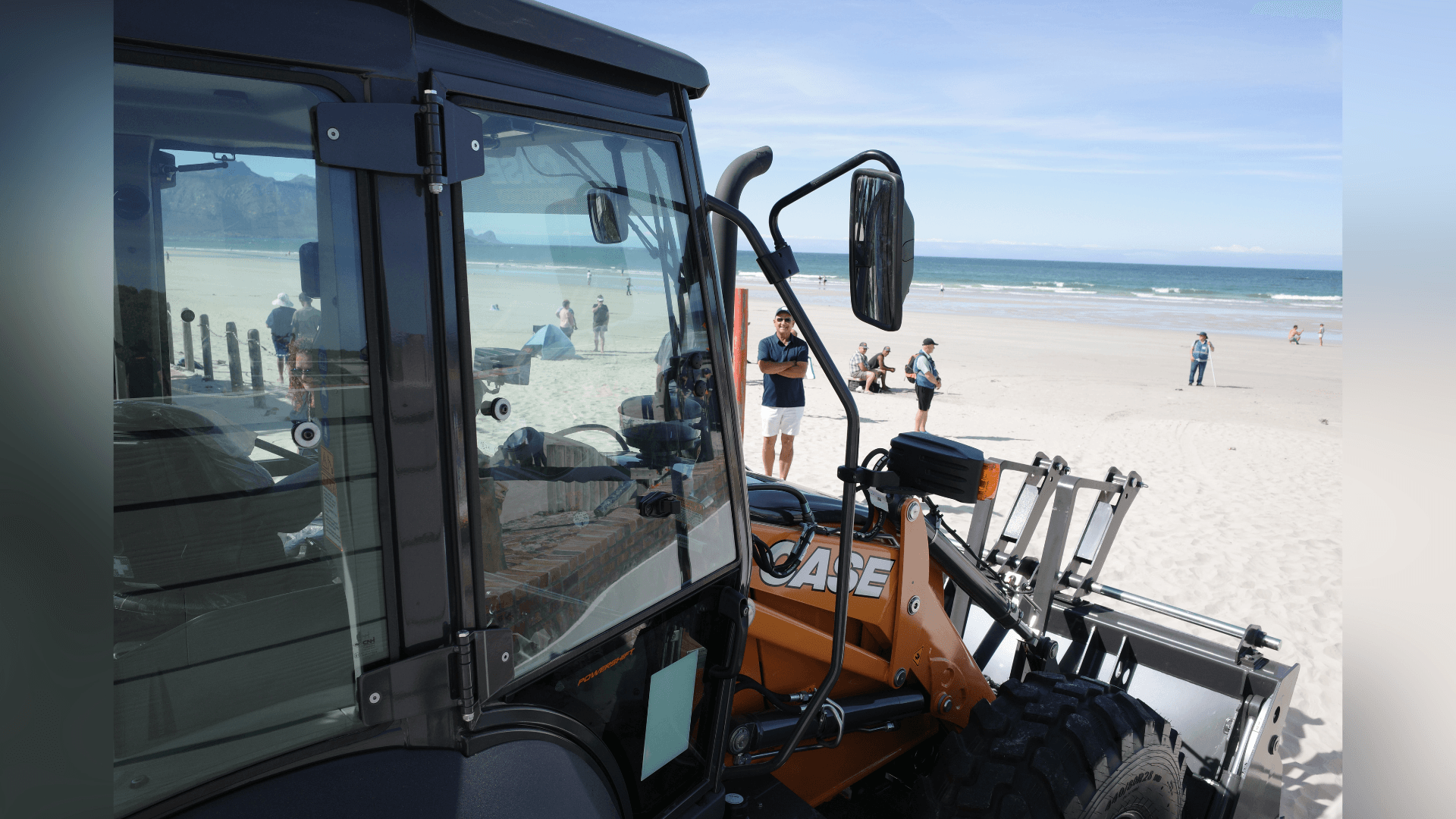
Supporting the cleanup effort was the CASE 695SV Backhoe Loader, a star of the demonstration. Known for its fuel efficiency and high-performance design, the 695SV was used to manage and move collected waste, showcasing how modern machinery can support sustainability efforts.
For the construction and agricultural sectors—industries that underlie South Africa’s economy—this fusion of machinery and environmental action symbolises the role technology must play in a changing world.
Global Expertise Meets African Coastlines
Adding international scientific depth to the programme was Dr. Laura Pintore, a WWF Italy marine wildlife specialist, who focuses on marine megafauna conservation.
Her involvement underscored:
- The global nature of plastic pollution
- The shared responsibility nations have to protect oceans
- The commitment of CNH to align this project with internationally recognised environmental science
Dr. Pintore helped children understand how plastic affects creatures like seals, dolphins, and turtles—species iconic to South African waters but increasingly threatened by human activity.

Miss Earth SA: Leadership Through Environmental Action
Environmental activist and National Director of Miss Earth South Africa, Catherine Constantinides, brought a message of empowerment and responsibility. For over two decades, Miss Earth SA has cultivated young women leaders dedicated to sustainability.
In her address, Constantinides emphasised genuine partnership and meaningful impact:
“The value of this collaboration lies in its authenticity. When organisations come together with a clear purpose and commitment, the changes become real.”
The Beach Care Project was strengthened by the presence of Ms Jenique Botha, Miss Earth 2025, who helped spark a broader conversation on youth leadership, climate action, and community involvement.
A Milestone for CNH and for South Africa
The Beach Care Project was presented to the Italian Consulate in Cape Town, recognising the diplomatic and institutional support behind the project. It also reaffirmed Italy’s commitment to marine conservation partnerships within South Africa.
For Daniela Ropolo, Head of CNH EMEA Sustainable Development Initiatives, the heart of the project lies not in the machines or the scale, but in the consistent investment in young people:
“The most powerful investment we can make is in the next generation. With the Beach Care Project, we have been working towards a cleaner future for more than six years. This is the true value of the initiative.”
Her message echoed across the day’s activities: sustainability is not a single event—it is a continuous, multigenerational effort.

Why This Matters for FarmSpace Readers
While the ocean may seem distant from the farmgate, the agricultural and coastal worlds are deeply connected.
Healthy oceans support:
- Climate stability
- Rainfall patterns
- Fisheries and coastal economies
- Biodiversity essential to global food systems
Plastic pollution and environmental degradation impact agriculture through shifting climate systems, reduced water quality, and the loss of ecological services.
Moreover, South Africa’s farming and construction industries—many reliant on CNH and CASE equipment—are increasingly expected to contribute to cleaner, more responsible environmental practices.
The Beach Care Project is a reminder that sustainability is shared across sectors and landscapes.
A Generation Inspired
As the sun set on Strand Main Beach, the sand was cleaner, the children more knowledgeable, and the partner organisations united in purpose. But the real story lies in what happens next—when these young ocean guardians return home and share what they have learned.
In them lies the future of South Africa’s coastline.
The launch of the CNH Beach Care Project is not an ending, but a beginning:
a new chapter in a growing global journey where education, community, industry, and environmental science come together to protect the ecosystems we all rely on.
And for the children who proudly carried bags of collected waste, those who touched the oceans artefacts and those who listened to the experts with wide-eyed fascination—this day may have been the spark that shapes their future.


