


Discovering South Africa’s Grasses: Cynodon dactylon
Name Origin and Common Names The genus name “Cynodon” was


Name Origin and Common Names
The genus name “Cynodon” was derived from the Greek words for dog and tooth - kuon odous. The specific epithet, “dactylon”, comes from daktulos, also a Greek word meaning finger. This term refers to the digitate inflorescence of the plant, which is arranged like fingers on a hand.
Cynodon dactylon is commonly referred to as Bermuda grass (E), Quick grass (E), Kweekgras (A), Fynkweek (A), Gewone kweek (A), uQaqaqa (X), uQethu (Zulul); Mohlwa, (S)
Description
Highly variable, hardy, and long-lived, Cynodon dactylon is a perennial grass forming short, thick mats that easily spread through stolons and rhizomes. These stolons spread in a creeping fashion, generally reaching lengths of 0.5 – 1m, however, they may be as long as 20m. The culms, or stems, are between 50 and 400mm tall, and densely rooted at the lower nodes. They are numerous (8-40) and typically prostrate, however flowering culms can be erect or geniculated, between 100 and 900mm high.
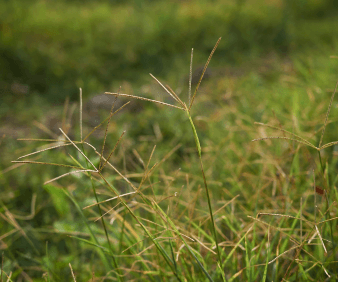
The inflorescence of this grass is exclusively digitate, consisting of 3-7 slender spikes of up to 600mm in length and arranged terminally on the axis. The spikelets, 2 – 2.5mm long, are flat and without awns. Bermuda grass is a very leafy species, with leaves typically pointing upwards. The flattened leaf blades are a blue-green color, 20-200 mm long, and 2-6 mm wide with a sharp tip. The root system of this grass species mostly develops 0-250 mm deep but can go as deep as 700-800 mm in sandy soils. The underground biomass is mostly rhizomatous.
Distribution and Habitat
Cynodon dactylon is a well-known grass found almost everywhere in the world, from grasslands and deserts to lawns to pastures. Believed to have originated around the Indian Ocean basin, from East Africa to India, Bermuda grass is a major tropical grass found in almost all tropical and subtropical areas today. Its range extends remarkably, reaching as far north as 50°N in Europe and as far south as 37° in the southern hemisphere. It is widely distributed in southern African countries, including South Africa, and can be found in biomes such as Grasslands, Savannas the Nama-Karoo, and Fynbos areas. It commonly occurs in disturbed areas, such as gardens, roadsides, overgrazed or trampled areas, uncultivated lands, in areas where the soil has high levels of nitrogen, and is also often found along rivers.
This grass flourishes in regions where temperatures range from 6 to 28°C annually, with optimal growth between daily temperatures of 17-35°C. It ceases growth below 15°C and can withstand temperatures as low as -2 to -3°C, below which the foliage will die. In these temperatures, it can regenerate from its resilient rhizomes. Owing to its deep root system, Bermuda grass is tolerant of both dry and flooding conditions, with the ability to tolerate up to 7 months of drought and several weeks submerged in water. It requires an annual rainfall between 625-1750 mm per annum, but it displays adaptability to moisture levels ranging from the lower end of 550 mm to the higher end of 4300 mm. It is, however, sensitive to shade and may struggle to survive in medium to densely shaded conditions. Additionally, it is susceptible to various pests and diseases, including rust, leaf spot, and parasites.
Nonetheless, Bermuda grass can be found thriving in almost all soil types, particularly favoring fertile soils like loamy soil for optimal growth and development.

Production
The spreading ability of Bermuda grass is rather extraordinary, with stolons being able to grow more than 7.5 cm/day. Dry matter yields typically range between 5 and 15 t/ha, however, its high responsiveness to nitrogen fertilization and irrigation can result in yields of up to 20 t DM/ha/year with significant input levels. Hybrid varieties are unable to produce seeds, they are propagated vegetatively by planting pieces of the rhizomes – known as sprigs – in the soil on a 900 mm grid. For non-hybrid varieties, dehulled seeds are sown on a well-prepared, fine bed.
Ecology
This resilient pioneer grass species plays a vital role in the restoration of disturbed soil, as it quickly and easily establishes. Its robust root system not only binds soil, preventing erosion on bare ground but also enhances soil structure and promotes nutrient recycling. Its pioneering habit and its good tolerance of saline soils make it a valuable soil binder in sandy dunes along seacoast or river banks. Bermuda grass also serves as feed for numerous wildlife species such as the white rhino, reedbuck, and impala, which in turn aid in the dispersal of this grass species which is essentially wind-pollinated.
Bermuda grass is a highly competitive grass species that develops rapidly, often displacing many other grass species. Only strongly competitive legumes can be successfully sown alongside Bermuda grass. Once established, it exhibits exceptional resilience to grazing pressure and can easily withstand heavy grazing. This tolerance is even further enhanced when Nitrogen fertilizer is applied. The quality of this grass is greatest when grazing pressure is high for short durations, allowing for rotation.

Uses of Cynodon dactylon
Primarily valued as fodder, Cynodon dactylon – with its ability to withstand heavy grazing – is suitable for both grazing and cut-and-carry systems. It is also used as an animal feed in the form of hay, silage, and pellets. Beyond its agricultural uses, Bermuda grass plays a crucial role in soil conservation, acting as a binder to prevent erosion. Its resilience and adaptability make it an ideal choice for lawns and turf grass, enhancing landscapes while being relatively tolerant to a variety of climatic conditions. In traditional medicine, it is often used to treat indigestion and for wound healing. Furthermore, its versatility extends to the fermentation process, where it adds a sour note to beer, reflecting its cultural significance. In regions like the USA, Bermuda grass retains its nutritional value during winter, serving as deferred feed for cattle after proper fertilization and rest periods. Its ability to thrive in irrigated areas and effectively utilize swine wastewater highlights its potential for sustainable agricultural practices and environmental management.
Similar Species
Eight species of Cynodon are native to southern Africa, each contributing to the region's biodiversity. Among these varieties, two main types dominate seeded varieties and hybrids. Seeded varieties – such as the Common Bermuda grass and Giant Bermuda grass – boast wide-ranging genotypes, selected for their resilience to drought and heavy grazing; crucial traits for tropical forages to be successful. These varieties, often blended commercially, offer adaptability to various cultivation conditions. In contrast, hybrids represent a significant advancement in Bermuda grass breeding, originating from the Coastal Plain Experimental Station in Tifton, Georgia, USA, in the 1940s. Notable hybrids include Tifton 44, 68, 78, and the widely acclaimed Tifton 85, renowned for its robustness and productivity. Coastal Bermuda grass, the first hybrid released, exhibits enhanced drought resistance, larger foliage, and immunity to root-knot nematodes compared to common Bermuda grass. Tifton 85, distinguished by its height and foliage density, revolutionized herbage production in the Southern United States, despite being less winter hardy than other hybrids. The introduction of these hybrids has significantly bolstered forage yield and quality, thereby transforming the livestock industry landscape.


