


DISCOVERING SOUTH AFRICA’S GRASSES PART 3: Cenchrus ciliaris
Name Origin and Common Names: The word ‘Cenchrus’ is derived


Name Origin and Common Names:
The word ‘Cenchrus’ is derived from the Greek word kegchros, which refers to a type of millet. The epithet of the species name, ‘ciliaris’, is a Latin word describing short hairs, such as an eyelash, which possibly alludes to the hairy bristles surrounding the spikelets. There are 22 tropical and warm temperate species in the ‘Cenchrus’ genus, one of which is indigenous and three which are naturalized in southern Africa. Of these, C. ciliaris is the only widespread species.
Common names for Cenchrus ciliaris include Foxtail Buffalo grass (English), Buffel grass (English), Bloubuffelsgras (Afrikaans), Buffelsgras (Afrikaans), Blaubüffelgras (German), Mfhafha (Sotho), Modikangwedsi (Tswana) and inTungamuzi (Zulu).
Description:
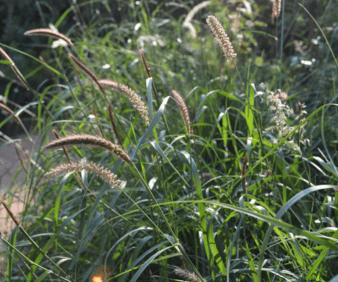
Foxtail Buffalo grass is a highly variable, tufted tussock-forming perennial grass with a shrub-like growth habit that grows between 600 mm and 1000 mm in height. The inflorescence of this grass has a bristly false spike – 40 mm to 120 mm long – that varies between a beautiful dense purple and more of a straw color. The bristles of the spikelet are between 2mm and 5mm long, with the outer ones being scabrid and slender, whilst the inner bristles are more plumose but still slender.
These spikelets fall off in their entirety upon reaching maturity. The culms of Buffalo grass are multi-branched and erect, reaching lengths of up to 1000 mm. The leaves are linear blades, 4 mm – 10 mm wide and 100 mm – 250 mm long, appearing green to bluish-green, depending on the specific cultivar. These leaf blades are furthermore also densely covered with fine, soft, and somewhat downy hairs. The rootstock of this grass species is tough and may grow as deep as 200 mm. Its flowering period is between August and April.
Distribution and Habitat:
Cenchrus ciliaris thrives in arid regions across southern and tropical Africa, Mediterranean areas, Arabia, and India. It was introduced to Australia in the late 19th century to be used as cultivated pasture and has since spread extensively throughout tropical, subtropical, and warm temperate regions. Its presence is observed in both cultivated and naturalized forms in various locations and certain areas, particularly arid and semi-arid environments in northern America, Hawaii, Mexico, and northern Australia, its spread has been so extensive that it is considered an invasive species and has been declared noxious.
This grass flourishes in warm and dry environments and is commonly found in open bush, woodland, and grassland, as well as along roadsides, where it can efficiently utilize the additional rainwater runoff. It thrives in well-drained sandy soils but struggles with heavy soil types due to its intolerance to waterlogging. After approximately six days of waterlogged conditions, Foxtail buffalo grass will drown and die off. Optimal growth conditions for this grass species include a soil pH range of 7 to 8, annual rainfall of 375 to 750 mm, and day temperatures between 30°C to 35°C on light, fertile, well-drained soils and below 1,550 meters above sea level. While it does have a moderate tolerance to salinity, it's highly sensitive to elevated levels of aluminum and/or manganese. Furthermore, Buffel grass also exhibits a remarkable tolerance for fire.

Production:
Establishing Cenchrus ciliaris is relatively straightforward but demands delicate handling. Optimal planting periods in environmentally suitable areas span from late January to mid-February, aligning with frequent and reliable rainfall events. Seeding rates vary, ranging between 4 kg/ha for fields with lower production potential to 6 kg/ha for more fertile areas, while pelleted seeds can be planted at rates of 5 kg/ha to 8 kg/ha.
When harvested during the early flowering stage, this grass yields reasonably good quality hay. Without applying fertilizer, Foxtail buffalo grass will produce around 2 tons/ha in regions with lower rainfall, and up to 12 tons/ha in areas with abundant rainfall. When boosted with a complete fertilizer, Foxtail Buffalo grass offers high-value forage with yields between 18 t/ha and 24 t/ha. However, these figures are substantially influenced by a combination of factors including rainfall patterns, fertilizer type, and application, as well as grazing management.
As Cenchrus ciliaris matures and grows excessively tall, it tends to become less palatable for animals due to the development of numerous thick stems, which they tend to avoid while grazing. Integrating this grass into an animal production system therefore calls for strategic planning, with emphasis on the importance of alternative uses for pasture species. Foxtail buffalo grass shows great potential to be used as foggage, retaining some quality during winter to sustain animal weight, especially when supplemented with a winter lick.
Ecology:
Cenchrus ciliaris stands out as one of the most adaptable grasses to semi-arid environments, proving invaluable for erosion control in such regions. In Australia, it was extensively utilized for revegetation and erosion control across various natural spaces from the 1960s to the mid-1970s. However, its tussocky growth pattern limits its ability to achieve complete ground cover.
This grass displays an aggressive nature attributed to its root system and allelopathic tendencies towards other seeds, often out-competing native pastures in areas like Australia and the southern United States. It spreads rapidly and holds a remarkable tolerance for fire. C. ciliaris is inclined to thrive in fire-prone environments, resulting in increased coverage and a decline in populations of other fire-sensitive species. Controlled fires are prescribed at intervals of 1 to 3 years, not only to enhance the productivity and nutritional value of C. ciliaris as forage but also to restrain the growth of woody plants.
Its aggressiveness extends further due to its extensive root system, engaging in robust competition with associated species for water and nutrients. While high oxalate levels in this grass can lead to 'big head' syndrome in horses and oxalate poisoning in young or underfed sheep, mature ruminants rarely face such issues due to lower soluble oxalate levels of 1‒2% in the dry matter.

Uses of Cenchrus ciliaris:
Cenchrus ciliaris holds significant value as a pasture grass, particularly in tropical regions. It finds widespread cultivation for permanent pastures and leys across Central Africa, East Africa, and northern Australia, serving as a prominent forage grass in India.
After harvesting the seeds, the mature grass can provide low-quality roughage for feeding livestock during drought periods when supplemented with additional feed. While it's less commonly used for silage due to its low moisture content in semi-arid areas, C. ciliaris remains highly palatable to livestock.
Once established, it can endure heavy grazing and trampling, offering sustenance for livestock even during dry spells, due to its proven resilience in arid regions. Some varieties exhibit robust growth during the wet season and might serve as valuable standover feed for winter grazing, especially when supplemented with urea and molasses.
In India, the seeds have culinary uses, employed in making bread or consumed raw. The grass boasts several cultivars, predominantly developed in Australia, with some variations found in Africa. In regions where grain crop production is prevalent, like the Northwest and central areas, Foxtail buffalo grass typically fits well within a cropping system for approximately five years. Following this cycle, the soil should ideally recuperate adequately to support annual grain crops under a CA (Conservation Agriculture) system.
Similar Species:
Cenchrus ciliaris exhibits considerable regional variation in color and size, contributing to its variability. It can be mistaken for Enneapogon cenchroides, as 'cenchroides' implies its resemblance to Cenchrus. However, a notable distinction lies in their panicle structure; E. cenchroides showcases a contracted, branched panicle, unlike the unbranched spike characteristic of C. ciliaris.


