


Discovering South Africa’s Grasses: Themeda triandra
Name Origin and Common Names The origin of the genus


Name Origin and Common Names
The origin of the genus name Themeda is not exactly clear, but it seems to have Arabic roots, possibly related to water or the absence thereof. The species name, tri (meaning three) and andr (meaning man), is of Greek origin, denoting the three male spikelets surrounding the bisexual spikelet in each cluster.
Commonly, Themeda triandra is known as Red Grass (English), Red oat grass (English), Rooigras (Afrikaans), Angelgras (Afrikaans), Seboku (Sotho), and iNsinde (Zulu).
Description
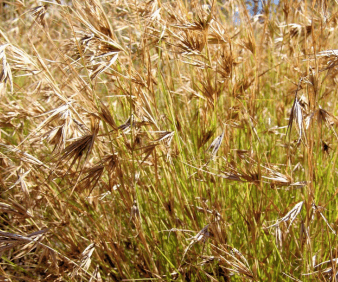
Themeda triandra is a perennial tufted grass with green to blue-green leaves that frequently exhibits a pink flush, and transitions to a red hue later in the season as it matures. The slender, erect, and many-branched stems (or culms) of this plant are often a bright yellow color and can vary between 300mm and 1500mm in length, depending on where they are found.
In higher altitudes, red grass tends to be shorter, whereas at lower altitudes it is often taller. The flowering part of this grass, or the spikelets, are wedge-shaped and usually form hanging clusters. These clusters are sometimes hairy, with long black or white hairs.
Distribution and Habitat
Red grass is widely distributed throughout all nine provinces of South Africa and can also be found in the tropical and subtropical parts of the Old World (the parts of Earth known to Europeans before the voyages of Christopher Columbus). Typically, this species of grass can be found at sea level and up to altitudes of 3000 m, in warm-wet or cool-dry climates such as undisturbed, open grassland and bushveld areas where the average rainfall is moderate to high (500-800 mm to 6250 mm per annum).
It can also grow on a wide range of soils, including loose sandy soils and alluvial silts, but does not stand heavy clays and prefers soils with higher content of organic material. Red grass benefits from well-drained soil for pasture growth and has shown some resistance to drought, however, it is quite vulnerable to flooding. This grass thrives in areas with full sun to partial shade.
Furthermore, it also has a unique ability to withstand fires due to its seeds being naturally buried up to 2.5 cm deep, keeping them relatively unharmed by the effects of fires. A fire followed by rain can promote its growth by enhancing seed germination, which is why this species tends to be absent in areas where protection from fire is prevalent.


Ecology
Themeda triandra is perennial tufted grass with a high grazing value that grows for longer than five seasons. As a climax species, the presence of T. triandra is an indicator that the veld is in good condition, however, its susceptibility to overgrazing is high, meaning it quickly disappears in areas where grazing is not properly managed. Even if stocking rates are reduced after overgrazing, Themeda populations will probably not recover fast enough due to its high palatability. A decline in the abundance of T. triandra in grassland is usually followed by a decline in the overall grazing value, biodiversity, plant cover, and ecosystem function of that area.
Red grass is also a fire climax species and one of the first plants to grow after a fire. It becomes more resistant to fire when burnt at regular intervals if overgrazing after germination is prevented.
Uses of Themeda triandra
Themeda triandra is greatly significant as a source of grazing, particularly during its early stages of growth. During this stage it is highly palatable to both livestock and wildlife and is best grazed when approximately 70% of the grass is green. This typically occurs about six weeks after the grass begins its growth. This grazing period lasts for four weeks during short rainy seasons and extends to six weeks during long rainy seasons.
When harvesting Red grass for hay, the best time to do so would be at the end of the growing season. Dry matter yields typically range from 0.5 to 5 tons per hectare, and it is important to refrain from frequent cuttings as this can reduce the longevity of the grass stand. Optimal results are obtained with an eight-week cutting interval, which maximizes the dry matter yield. In fact, this longer cutting interval can boost the dry matter yield by as much as 60% when compared to a two-week interval.
Even though it primarily serves as feed for animals, its grain can also be consumed by people, which has been the case, particularly during times of food scarcity. Additionally, its stems and leaves can be utilized as bedding for animals and as a source of fibers for crafting paper, baskets, and thatching materials. While it is used for thatching in some parts of Africa, the forms found in southern Africa are typically too flimsy for this purpose. However, in Lesotho and nearby areas, it is occasionally employed for thatching and some basketry. Its culms (stems) can also be used for making paper pulp.
In addition to this, red grass holds immense importance for the health of ecosystems in the open grassland regions of Southern and East Africa. While it is palatable and serves as good grazing, its value primarily lies in the fact that it dominates the landscape, forming dense stands that are vital to the ecosystem.
Similar Species
Worldwide, 18 species of Themeda are found, of which only T. triandra occurs in Southern Africa. It is very closely related to another Themeda species called T. australis (commonly known as kangaroo grass), which is commonly found in Australia.


