


Discovering the Angus
During the early 1800s, England’s agricultural sector underwent a massive


During the early 1800s, England’s agricultural sector underwent a massive transformation that would forevermore change the way in which they operate. This transformation was so powerful it was aptly called the British Agricultural revolution, reaching its peak around 1808. In this time, major strides were made in boosting the production of food in order to meet the rising demands and living standards of the British people. These transformations were linked to major agricultural advances such as crop rotation, the more productive use of arable land and selective breeding practices – the latter of which played a crucial role in the development of the amazing and diverse Angus; superiorly known for being “more than just a breed, it’s a brand” – Angus Society of South Africa.
During this time, a small framed, polled cattle breed from North-East Scotland had gained immense popularity among the English, who firmly believed that the most delectable meat came from the northern side of the border. More specifically, these mostly-black cattle were from the Scottish regions of Angusshire – where the cattle were referred to as “Doddies” – and Aberdeenshire – where they were called “Humlies”. The Aberdeen Angus breed (or Angus as they are known internationally) was founded predominantly by three Scottish cattle breeders who were very passionate about improvements in animal husbandry, widely gathering stock and producing cattle of outstanding quality and character.
One of these, laird Hugh Watson from Angus County, is considered the founder of the breed, precisely selecting only the best black and polled animals for his herd – his strict selection criteria only included animals that would produce high-quality meat, were docile, and easy to raise. A vast majority of the Angus cattle alive today can trace their ancestry back to two of his animals; his favourite bull, Old Jock, who was named as the number one bull by the Scotch Herd Book, and Old Granny, a pristine cow that produced 29 calves in the 35 years she was in his care.
In 1824, a man named William McCombie from Aberdeenshire, the county just above Angus, established a sizable herd of cattle derived from Watson's bloodlines. With utmost dedication and hard work, McCombie continued to refine the breed, meticulously keeping records during the entire process. When McCombie was satisfied that this breed has been perfected, he actively promoted these animals throughout England and France, where they became known as the Aberdeen-Angus cattle. As their reputation soared, they were also introduced to the American West, specifically in Kansas and Missouri, to improve the beef market in those regions. Today, Black Angus cattle have attained the status of being the most favoured beef breed in the United States, with a staggering 324,266 animals registered in 2005.
Over the years, the Angus has become a leading international beef breed due to the excellent quality of its meat, the fact that it is polled, and its good feed conversion ratio, which means it is able to reach an acceptable marketing weight in a short period.
The potential of animals with the abovementioned traits in a country such as South Africa is what prompted Charles Newberry, a farmer from the Free State, to import the first ten Black Angus cattle to South Africa in 1895. Due to their remarkable and evidently superior traits, as well as the significant economic advantages achieved when crossbreeding them with native cattle, these animals slowly but surely won over the favour of stockmen. As a testament to their growing popularity, the Angus Cattle Breeders Society of South Africa was formed in 1917 with just 12 members, solidifying their presence and recognition in the country.
Since its humble beginnings, the Angus breed has grown with leaps and bounds in South Africa. Over the past century, the decision to improve the beef qualities of native breeds by crossbreeding them to Angus cattle have proven to be utterly successful, and as such they have become a favourite option for farmers looking to better their herds. At present, Angus cattle are extensively utilized throughout South Africa, and there are several distinctive traits that serve as trademarks of the Angus breed, contributing to their exceptional performance in the South African market.
Angus cattle are homozygous polled, meaning they naturally lack horns—a highly desirable trait for ease of handling and reduced risk of injury. The polled gene is inherited as a dominant characteristic in all Angus offspring, making them inherently hornless. This genetic advantage serves as a natural dehorner eliminating the need for manual horn removal procedures. Horns, if present, can often lead to bruising, tearing, and severe injuries for both the animals and their handlers. By choosing Angus cattle, one demonstrates a commitment to good animal care, prioritizing the well-being and safety of both the animals and those who handle them.
Additionally, Angus cattle demonstrate lower birth weights, facilitating easier calving and minimizing the incidence of dystocia. Angus cows also exhibit exceptional milking abilities and demonstrate proficiency in rearing their calves, making them highly sought after for breeding purposes. The calves produced from Angus cattle are vigorous, lively, and strong, with the instinct to get up and suckle within moments of being born. The milk of an Angus cow is sufficient to the point that she can easily wean a calf each year that more than exceeds half her body weight.
The Angus cow excels at her job, whether she just had her fist or her fourteenth calf - the ability of an Angus cow is nearly- and not at all unusual for 12- and 13-year-old Angus cows to still be productive.
The breed also boasts impressive growth rates, enabling Angus cattle to efficiently reach optimal weights. They display early maturation and high carcass yields, with well-marbled meat.
In South Africa, the cattle are usually market-ready by the time they reach twelve to fourteen months of age. Angus cattle have earned a reputation as a carcass breed, and the superior meat quality of Angus carcasses commands significant demand in the market, appealing to discerning consumers. They offer natural marbling, resulting in flavourful and tender beef that aligns with the market's demand. The heritability of marbling is moderately high, and selecting for marbling also improves tenderness. Utilizing Angus cattle with their superior marbling ability enhances beef tenderness and boosts consumer acceptance. Additionally, research indicates that Angus sires can be chosen to produce progeny with a higher likelihood of grading AAA, without compromising feed efficiency, animal growth, or sacrificing carcass quality by increasing yield grade.
Their widespread use in crossbreeding aims to enhance carcass quality and milking ability in breeds that may lack in these areas. Furthermore, Angus cattle exhibit resilience against harsh weather conditions, showcasing their adaptability and hardiness - they will thrive under any weather circumstances with minimum intervention. They are undemanding in terms of care and maintenance and are known for their amiable nature. These distinctive features collectively contribute to the Angus breed's success and prominence in the South African cattle industry.
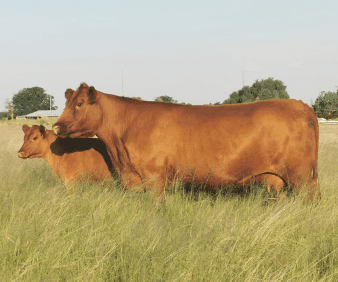
Despite the more well-known black coat of the Angus, they can be either black or red in colour. The development of the red colour variation in Angus cattle is believed to have occurred when Scottish breeders imported predominantly red Longhorn cattle in the eighteenth century for the purpose of breeding larger draught oxen. Another theory suggests that Watson, a prominent breeder, chose to focus on breeding for a black coat despite having Angus cows of various colours. In America, the Red Angus and Black Angus are considered distinct breeds, however besides the coat colour no genetic differences exist between the two, extending to the meat qualities as well. In South Africa, Red Angus cattle are preferred by producers, as evidenced by the more than seventy percent of Angus cattle listed on SA Studbook being red. This could be due to the claims that animals with red coat colours are less sensitive to heat stress, with a reduced risk of cancer and sunburned udders. Conversely, in the rest of the world, more than ninety percent of listed Angus cattle are black.
Angus cattle have evolved beyond being just a breed; they have become a recognizable brand in the beef industry. The global market demand for Angus Beef presents limitless opportunities for the Angus breed, with the industry expanding rapidly. Angus cattle have achieved international prominence, being the dominant breed in countries such as the USA, Canada, Argentina, New Zealand, and Australia. Remarkable advancements have been made in this breed, maintaining favourable birth mass while significantly improving other growth factors and unsurpassed fertility.
While the Aberdeen-Angus breed traces its origins to Scotland, it thrives in South Africa due to its exceptional meat quality, maternal abilities, and various other traits, making this breed an asset to the South African beef industry and its future.


