


From the outback to the veld: The rise of the Droughtmaster Cattle Breed
The beautiful region of Southern Africa is well-known for its


The beautiful region of Southern Africa is well-known for its vast array of climatic
conditions that often results in prolonged droughts or extended periods of heavy rains.
The beautiful region of Southern Africa is well-known for its vast array of climatic conditions that often results in prolonged droughts or extended periods of heavy rains. This range of extreme climatic differences presents a unique set of obstacles for agricultural activities, with only a small portion of the region receiving adequate rainfall for crop farming, and only a fraction of that being fertile enough to sustain crops - the rest is suitable only for grazing and extensive livestock production.
These tough conditions make cattle farming in Southern Africa a challenging affair, as traditional European breeds may have difficulty in adapting to such environments. In order to survive, thrive and be successful, farmers must use adapted, functionally efficient animals that calve annually, perform well, and easily reconceive. Given all these challenges and requirements, a breed like the Droughtmaster is perfectly suited for the advancement of cattle farming in Southern Africa. The Droughtmaster breed was initially developed in Australia, a country with similar diverse and harsh conditions to those we experience here in the most Southern tip of Africa. The origin story of this exceptionally well adapted and functional breed is rather interesting and unique; in 1910, three Zebu bulls were taken from the Melbourne Zoo to the northern regions of Queensland, Australia.
The zoo curator at the time made the bulls available to a few of his cattle farmer friends, who bred these bulls to cows from their own European-type herds. Greatly impressed by the offspring of the Zebu bulls, these pioneers kept the crossbred calves and continued incorporating them into their breeding programs for the next several years. In 1926, a well-known farmer, known as Mr. Monty Atkinson, was left astonished after seeing one of these groups of progeny from the Zebu bulls. Despite the severe drought prevailing at that time, these animals were in top body condition whilst also maintaining sufficient reproductive rates.
Queensland farmers at the time were suffering, severely discouraged by the inabilities of the British breeds as they simply could not adapt and perform adequately in those harsh conditions. In particular, the lack of heat tolerance of the Bos Taurus breeds and their susceptibility to tick infestations sent the beef production industry on a steep downward trajectory, with little hope of recovery if nothing was to change. It was for this reason that Mr. Atkinson was particularly excited when he saw the group of beautiful Zebu crosses and their ability to thrive under such conditions.
Here the plan was born to cross Bos Taurus and Bos Indicus animals and only select animals with the desired adaptability and fertility traits of both types. Mr. Atkinson brought in several Brahman bulls into the region and used them on Shorthorn and Shorthorn-Devon cross cows over the next few years, whilst other breeders used British breeds like the Hereford and Red Poll, but with similar breeding programs which included the Indicus bulls.
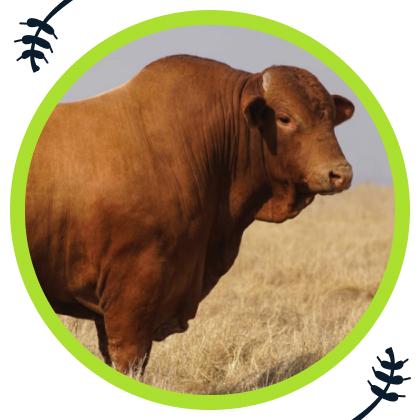
After years of selection and carefully planned breeding, a new breed emerged with an Indicus-Taurus ratio of about 50% each. These animals were smooth-coated, light to dark red in colour, medium-framed with traits that are functional-efficient, and met the current requirements of the commercial cattle farmer, and the related beef industry.
Like the Beefmaster in America and the Bonsmara in South Africa, the Droughtmaster emerged in Australia to face specific environmental challenges. Since its initial beginning, the Droughtmaster breed has developed into one of the most popular cattle breeds in the extensive parts of Australia today. Despite their popularity in their country of origin, little is known about the Droughtmaster and its successes outside of Australia.

The story of the Droughtmaster in South Africa begins with Johan van der Nest, a wellknown auctioneer and cattleman from the Vryburg area. When he travelled to Australia in the early 1990s, he came across the welladapted Droughtmaster cattle upon visiting Queensland. He was immediately fascinated by these red, uniform cattle with their somewhat differentiated look to some of the other breeds he had seen before, and it was not long before their abilities impressed and astounded him even further. At that time, he was a Beefmaster farmer, however the adaptability and of this uniform, functional breed in the harsh Australian environment was immensely exciting. The masculinity of the bulls and the heavy calves with the cows - who had more than enough milk - was striking. What Johan was particularly impressed by was its adaptability and fertility under the extensive, harsh conditions of Australia, as these conditions are often similar to the extensive environmental conditions of Southern Africa.
Although the Droughtmaster and the Beefmaster came about in a similar way, one aspect that distinguished the Droughtmaster to him was its genetic dominance. You could immediately identify the Droughtmaster bulls calves in commercial herds. Van der Nest was convinced that this breed could play a significant role in the South African beef cattle industry. Under the protection of the South African Beef master Breeders Association at the time, he obtained permission and imported several shipments of Droughtmaster bull semen, and in this way began to upgrade his Beefmaster herd to Droughtmasters. In 1999, permission was obtained from the former Registrar of Animal Improvement, Mr. Keith Ramsey, to import live animals from Australia.
That same year, 26 registered heifers and 2 bulls were imported to South Africa. When it came time for breeding and selecting the best animals, Johan placed a specific focus on the selection of medium-framed animals with good underlines. This carefully planned selection program led to the South African Droughtmaster as we know it today; a highly adapted composite cattle breed consisting of about three-eighths Indicus genetics and five-eighths Taurus genetics.
At present, there is a strong representation of Droughtmaster cattle genetics in South Africa, with experts increasingly being impressed by the breeds capabilities. The contribution of the Droughtmaster breed to the Beefmaster, Brangus and Simbra breeds in South Africa is also very evident in the herds where they have been infused. By means of well-informed, strict selective breeding programmes over the years, cattle breeders have been able to develop a breed that is well adapted to survive in SouthAfrica's diverse climatic environments.
The modern Droughtmaster cattle is renowned for its outstanding hardiness, adaptability and breeding efficiency, characteristics which make the breed an exceptionally valuable asset for both the Southern African beef producer and the Southern African beef industry. This is the breed that could revolutionise how extensive cattle farming in Southern Africa is performed, and it is clear that the future of beef production in Southern Africa would heavily benefit from the continued success of the Droughtmaster breed. With its unique combination of hardiness, adaptability, functional efficiency and pre-potency, the Droughtmaster is increasingly becoming the breed of choice for farmers in the industry.
With the continual increase in demand for high-quality beef, the Droughtmaster is poised to play an increasingly important role in the Southern African beef industry, and it is clear that this breed has a bright future ahead. It is important for livestock producers and industry experts to continually invest and support the breed, so that we can continue to reap the benefits of the Droughtmasters unique characteristics in the years to come.


