


Gift to Greatness: The Evolution of Santa Gertrudis
In 1910, a South-Texan farmer by the name of Thomas
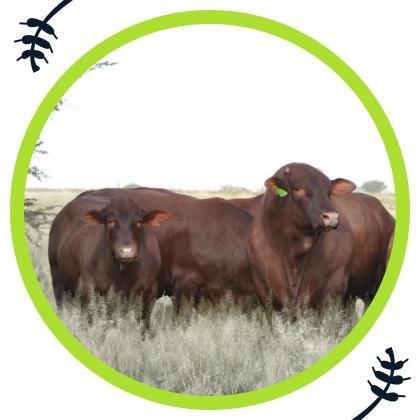


In 1910, a South-Texan farmer by the name of Thomas M. O’Connor generously gifted a half-Brahman, half-Shorthorn bull to the Kleberg family of King Ranch. If only he were able to see a few decades into the future, he perhaps would have opted to keep the animal to him-self and claim the honour of creating the superiorly dynamic breed of cattle that most cattle farmers know and love today.
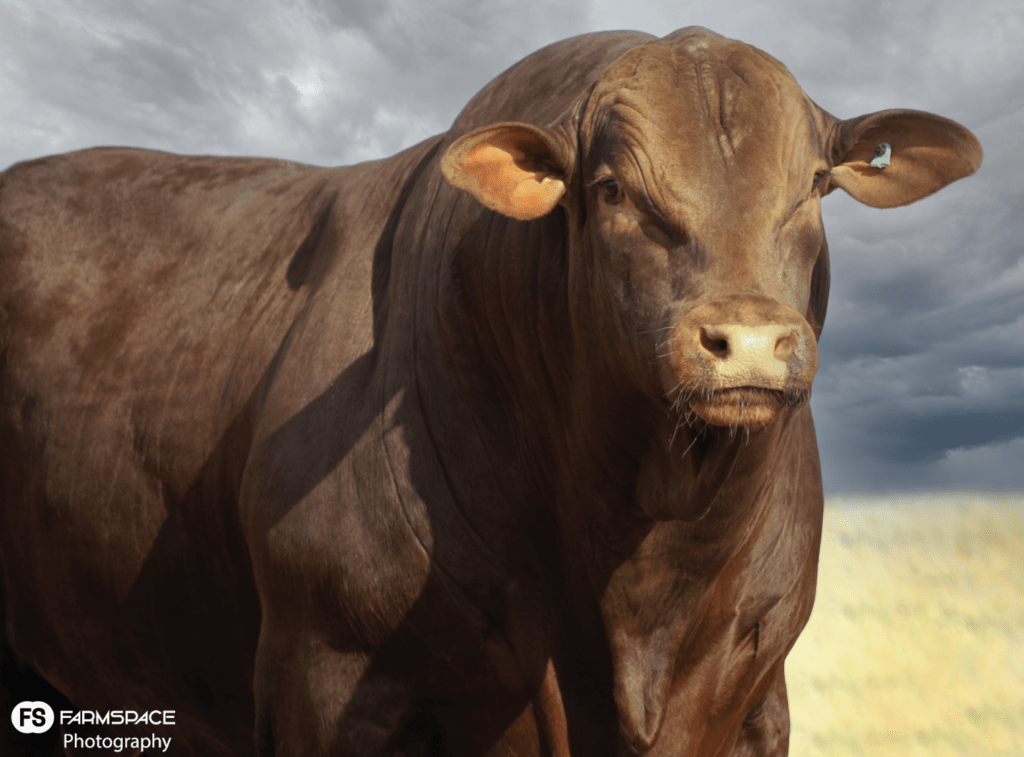
Its well hooded and focused eyes - a natural shield against the sun’s harsh rays – only further enhancing its striking appearance, whilst its strong and sturdy legs and feet, move with grace and agility - a true testa-ment to the exceptional creature born and bred in the harsh conditions of Southern Texas. Alas, Mr O’Connor, unbeknownst to himself, was the great catalyst putting into motion the creation of a beautiful breed of beef cattle known as the Santa Gertrudis.
Behold…the majestic Santa Gertrudis, whose coat shines with a rich, deep hue of dark red, exuding an air of elegance
and poise unlike any other.
Shortly after his arrival on King Ranch, this particular bull jumped the fence and – like any young and prolific bull should - mated with more than 3000 Shorthorn heifers, leading to the birth of a sturdy young bull calf named Chemmera. One of the Kleberg family members, Robert Justus Kleberg, Jr. was a true cowboy at heart. He was determined to overcome the harsh conditions of South Texas and breed the most exceptional heavy beef cattle imaginable. With a relentless spirit, he battled against the merciless sun, meagre pastures, and the constant onslaught of drought, pests, and diseases.
Despite these seemingly insurmountable obstacles, he remained steadfast in his pursuit of breeding the best of the best. The hardy offspring of Chemmera gave him the tools he needed to start the controlled development of a brand-new breed of cattle. Recognising the value of the Indicus traits, Kleberg obtained a Brahman bull named Vinotero to be mated with one of the offspring of Chemerra, a blood-red Shorthorn cow with one-sixteenth Brahman cattle blood running through her veins. The result was a dark-red bull calf of superior qualities and big personality - this calf was aptly named Monkey, and he would go on to produce progeny of uniform superiority and therefore be referred to as the father of the Santa Gertrudis. The name given to the breed might sound peculiar to those unfamiliar with the history of the region in which they developed, but the Kleberg family was actually paying homage to the original owner of the land, who named the region “Los Cerros de Santa Gertrudis” or Hills of Santa Gertrudis.
1918 was the year when Kleberg Jr. started to implement an extensive crossbreeding program, randomly crossing Zebu bulls imported from A.P. Borden – the same breeder where Vinotero originated from – to purebred Shorthorn cows and a few select F1 crossbred cows, allowing for limited interbreeding of the premium crossbreeds to establish a desirable type. He also imple-mented his selection strategy to achieve genetically based progress in weight gain, employing a vast number of cattle as a base for selection and continually remaining responsible for the selection and breeding process. With the growing success of this exceptionally adaptability breed, forged by nature to thrive in the harshest of climates, the King Ranch’s next goal was to establish a herd in Virginia. So much was the success of the 30 years of a well-defined breeding program that in 1940, the Department of Agriculture acknowledged the Santa Gertrudis as the first breed to be developed in the New World. And so, in 1943, the King Ranch loaned some Santa Gertrudis bulls to William DuPont to make the dream of a Virginian herd a reality.
The first of many public bull sales was held in 1951, where 29 bulls were brought for $99,000. Afterwards, the Santa Gertrudis Breeders Association, previously known as Santa Gertrudis Breeders International, was formed and settled in Kingsville, Texas. Only a year later, the second public sale was held, this time with bulls reaching bids of up to $27,000 and totalling in $212,550 for the 25 bulls sold on that day. Later that same year, King Ranch entered into a partnership with Australian cattlemen, shipping 272 head of cattle to North-Eastern Australia in a very successful attempt to upgrade their Hereford, Devon, and Angus cattle herds. Had these cattlemen known that by the early 1990s the Santa breed would have been promoted into a highly profitable enterprise - with thousands entering the market each year - they would have gone into this partnership even sooner. After purchasing the Virginia herd in 1966, King Ranch went on to produce many high-quality animals and spread then worldwide.
The Department of Agriculture acquired a batch of 20 heifers from Texan breeders, and 3 bulls who carried the well-known King-Ranch brand. At the time, the Santa Gertrudis served as a benchmark model of what an adapted breed should look like, after which the newly developing local breed, the Bonsmara, was patterned. It was only as a means of comparing the progress of the Bonsmara’s development that they imported these 23 animals. The imported animals and their offspring were initially held at the Mara Research Station in the Northern Transvaal for evaluation up until 1964, after which they were transferred to the Omatjenne Research Station in South-West Africa – known today as Namibia.
The move was motivated by the breeds excellent performance under the climatic conditions and nutritional standards of the Northern Transvaal. After this, the presence of the Santa Gertrudis in the Mara region silently disappeared, whilst the scientific records of these animals sent to Omatjenne mysteriously vanished, nowhere to be found!
The Santa Gertrudis was first imported to South Africa in the early 1950’s by the Department of Agriculture, as well as a few hopeful breeders looking to establish the breed in South Africa.
As for the breeders, located in the Vryburg region, they imported a total of 4 bulls and 16 heifers, who they exhibited at local shows and used for crossbreeding, with extremely impressive results – a massive testament to their potential here in South Africa. However, due to the difficulties of pertaining import permits and the lack of a breeder’s society in South Africa for the Santa Gertrudis, the owners sold the cattle to a Natal breeder in the 60’s. Once there, many of the cows were artificially inseminated, but later sold again. After years of struggling, permits to import this well-suited breed of cattle were finally obtained in 1965 by a man named Don Hillhouse. Don made a thorough study of the breeds history, the breeding policies, and the distribution of the Santa across the world, and finally decided to buy animals only from herds older than 25 years with roughly 1 000 approved stud cows – this would ensure that only established and dependable breeding material was acquired.
Throughout the 1960’s, more and more breeders imported the breed, leading to the recognition of the Santa by SA Stud Book. By 1974 more than 250 members, 13 000 registered cows and 2000 registered bulls were recorded. At the same time, news that results from the herd at Omatjenne were rapidly improving spread like a wildfire among cattle breeders, marking the time for this new, well adapted pure breed who performed just as well, and even better, than other crossbreeds. The Santa was the whole package: it was suitable to the feedlots, showed extremely good growth characteristics, was well-adaptable and had a great temperament.
Today, the Santa is a well-known breed throughout South Africa, notorious for its reputation as a top performer on the veld and in the feedlot; this breed never ceases in its abilities to adapt to the emerging tendencies of the beef industry and would be a prime pick for any farmer looking for a hardy, beefy, and adaptable breed to improve their herds.


