


John Deere Electric Tractor – Agritechnica Showcase & Sustainable Farming Innovation
7 min read|
⏳ 6-7 min - Estimated read time John Deere is
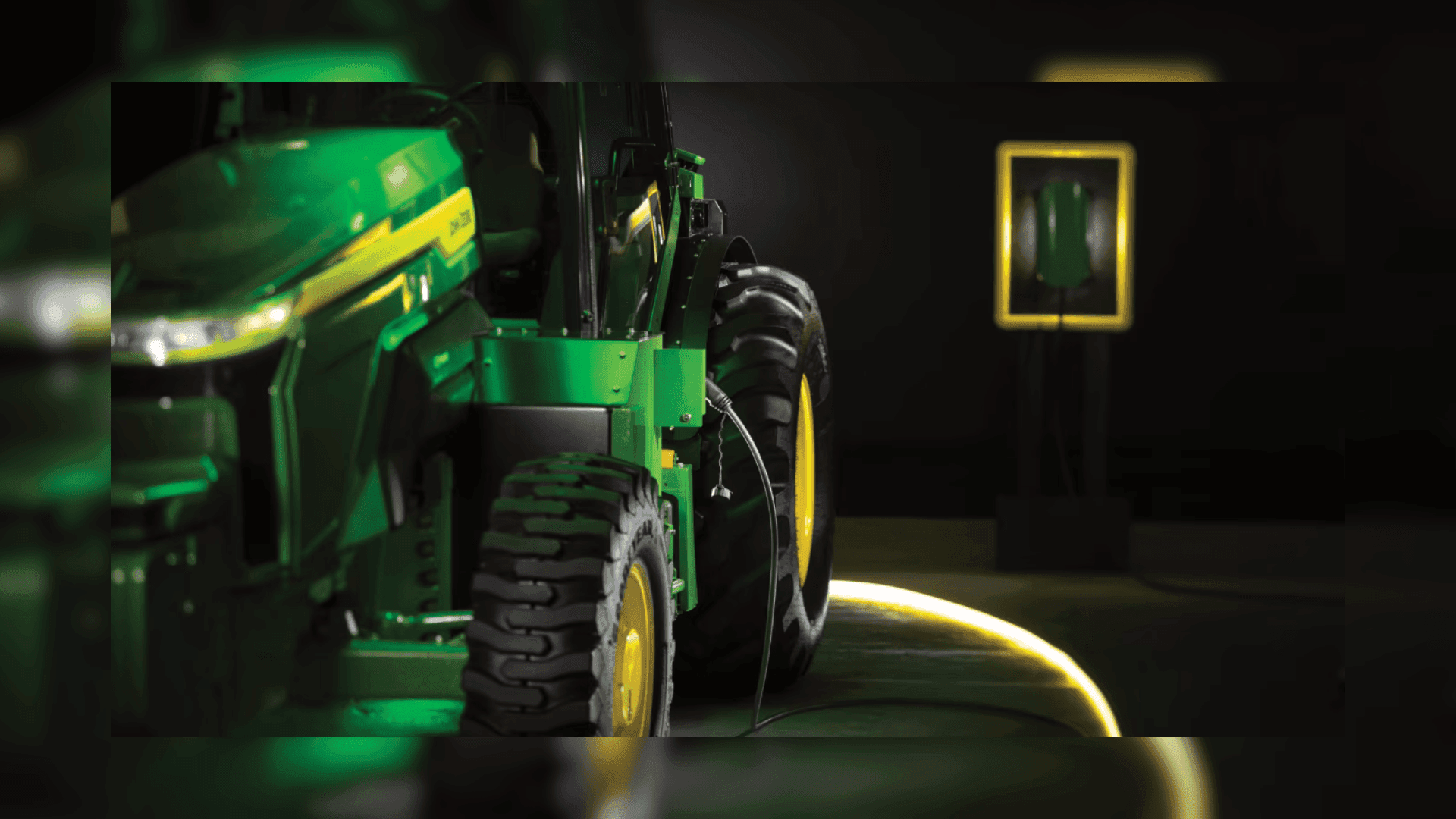

John Deere is not only renowned for its diesel tractors; it is also pioneering electric tractor technology as part of a broader push towards sustainable agriculture. In recent years, John Deere has developed a line of battery-powered “E-Power” tractor prototypes designed to match the performance of traditional models, but with zero emissions and lower maintenance.
John Deere will offer a glimpse of this future at Agritechnica 2025 – the world’s premier agricultural machinery exhibition held in Germany – where a fully electric John Deere tractor prototype is one of the event’s standout attractions.
Unveiling the E-Power Electric Tractor
At Agritechnica 2025 in Hannover, John Deere reveals the E-Power prototype – a purpose-built, fully battery-electric tractor developed from the ground up for agricultural applications. Unlike models such as the 6R or 8R, the E-Power forms part of a new electric platform designed to deliver the same capabilities as a conventional diesel tractor while operating more quietly and cleanly.
Key Specifications
- Power Output: Approximately 96 kW (130 horsepower) continuous power. This places it firmly in the mid-range utility category – ideal for front-loader work, mowing, tillage, and general field use. Despite being a prototype, Deere insists the E-Power performs on par with diesel equivalents while enhancing uptime and efficiency.
- Battery System: The tractor uses Kreisel Electric battery packs (a company majority-owned by John Deere). It can accommodate up to five modular battery units, allowing operators to tailor energy capacity to their workload. Each battery is liquid-cooled for thermal stability, enabling faster charging and prolonged lifespan. Deere has stated that the batteries are engineered to last the tractor’s lifetime.
- Run Time and Charging: Designed to operate for several hours per charge, the E-Power can recharge over a lunch break and resume work in the afternoon. A 100–130 kW DC fast charger restores 20–80% capacity in roughly one hour (or 45–50 minutes at peak rate), while a Level 2 charger (19 kW) enables overnight charging in about 5.5 hours. John Deere is also exploring mobile and Level 3 charging solutions for on-site flexibility. Battery swapping in the field will not be necessary; the system prioritises efficient plug-in recharging instead.
- Implements & Compatibility: The tractor retains the standard three-point hitch, PTO, and hydraulic connections, ensuring compatibility with all existing implements. High torque delivery from zero RPM and the absence of gear changes mean smoother, more precise control for farm operations.
In summary, the E-Power is a 130 HP, fully electric tractor built for versatility, dependability, and everyday agricultural tasks – a purpose-built machine rather than a retrofit experiment.
Performance, Operation, and Features
Farmers who have trialled the prototype describe it as remarkably simple to operate. With no clutch or gear shifts and minimal noise, it provides a driving experience described as “as quiet as a car, as easy to drive as a golf cart”.

Key Operational Advantages
- Instant Torque: Electric motors deliver full torque instantly, eliminating lag and enabling consistent pulling power for ploughing or towing.
- Reduced Maintenance: With far fewer moving parts, maintenance is significantly reduced – no engine oil, filters, or spark plugs. Routine tasks are limited to hydraulic oil changes and standard mechanical checks, cutting downtime and costs.
- Autonomy Ready: Built with the future in mind, the E-Power is fully compatible with John Deere’s autonomous and precision farming systems. At Agritechnica, the company will demonstrate its second-generation autonomy package – featuring 16 cameras and 360° vision – technology that the E-Power will fully support.
- Smart Connectivity: Integrated with the John Deere Operations Centre, the tractor allows remote monitoring of charge levels, run time, and energy efficiency. It can also feed telematics data on field performance and maintenance, while future updates may enable energy-sharing or grid interaction, turning the tractor into a mobile power hub.
Early testing feedback has been overwhelmingly positive. Farmers noted the quiet operation, ease of use, and environmental benefits, particularly for early-morning work or indoor tasks where diesel noise and fumes are problematic.
Agritechnica 2025 and John Deere’s Sustainability Vision
Agritechnica 2025 provides an ideal platform for John Deere to demonstrate its multi-path approach to sustainable farming. The E-Power electric tractor took centre stage in the company’s “Alternative Drive” showcase, appearing alongside models powered by renewable diesel and hydrogen.
John Deere’s sustainability strategy is technology-agnostic, focusing on multiple solutions rather than a one-size-fits-all approach. The E-Power represents the electric pathway, suited for specific sectors such as orchards, vineyards, and dairy farms – operations that benefit from low noise and zero emissions.
For larger-scale, high-horsepower work, the company continues to enhance diesel efficiency and explore ethanol and hydrogen combustion technologies. Together, these developments form the foundation of John Deere’s commitment to reducing agriculture’s carbon footprint while maintaining productivity and performance.
The E-Power was also submitted by John Deere’s Walldorf R&D Centre for the Agritechnica 2025 Innovation Award, highlighting its role as a serious engineering project – not merely a concept.
Path to Production and the Road Ahead
John Deere has confirmed that three E-Power prototypes are currently undergoing extensive field testing in 2025, each designed for different agricultural sectors (e.g., vineyard/orchard, utility, and compact models). The company’s target is to have customer-ready electric tractors operating on farms by 2026.
Electric tractors will not replace diesel models across the board but will serve as an alternative for suitable use cases. As one company representative stated: “We know an electric tractor will not be the right fit for every farmer… but the E-Power line-up will be an exciting addition, giving customers the freedom to choose what fits their operation best.”
Points to Watch
- Model Line & Naming: Possible introduction of a new RE-Series (“ReElectric”) family.
- Battery Range Options: Modular battery configurations could offer 4–8 hours of operation depending on load.
- Charging Infrastructure: Expansion of rural fast-charging capabilities will be key to adoption.
- Government Incentives: Subsidies and sustainability schemes may drive early uptake.
- Integration with Other Green Technologies: Deere continues parallel work on hybrid and ethanol engines, ensuring farmers have flexible solutions.
Conclusion
The John Deere E-Power tractor represents a major step forward for sustainable farming. Combining zero emissions, low maintenance, and autonomous-ready capabilities, it showcases how electrification can modernise agriculture without sacrificing performance.
As the prototypes move closer to production, John Deere appears poised to lead the charge in the agricultural industry’s clean energy transition. If all goes to plan, by 2026, we may see the first generation of fully electric John Deere tractors working fields – marking a new era where “Nothing Runs Like a Deere” will apply as much to electrons as it does to diesel.


