


New Drone Technology in the Agricultural Industry
Drone technology, commonly known as 'drones' or UAVs (Unmanned Aerial
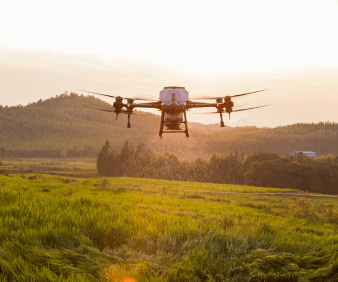

Drone technology, commonly known as 'drones' or UAVs (Unmanned Aerial Vehicles), has been utilized for quite some time by hobbyists and photographers. However, drone technology is increasingly finding a significant role in the agricultural industry, presenting immense potential to elevate agriculture to new heights. Currently, drones are employed in three main sectors within agriculture: security, inspection, and application.
Drones have become a crucial asset for addressing security concerns in agriculture. The Mavic 3-T (thermal) drone, equipped with a specialized thermal camera, enables remote investigation during the night. Its thermal imaging capability allows for a clear distinction between humans and animals, facilitating easy problem identification during nocturnal operations. The Mavic 3-T is also equipped with a standard color camera for daytime use, boasting a compact design and an 8km flight range with 45 minutes of flight time.

Inspection of crops at various growth stages is becoming increasingly important. The Mavic 3-M (multispectrum) drone is employed to identify plant stands, weeds, pests, diseases, and nutrient deficiencies. Its multispectral camera captures not only standard RGB (red, green, and blue) color bands but also 'Red Edge' (RE) and Near-Infrared (NIR) bands, providing valuable insights that are invisible to the human eye. Precision farming companies use the Mavic 3-M to identify and address issues in crops successfully.
This drone is flown at specific growth stages, allowing for targeted observations related to plant density, weed height, leaf diseases, and pests. Agricultural engineers or precision farming firms leverage the Mavic 3-M for specialized surveys, including designing dams, water drainage planning, contour mapping, and soil displacement assessments. Farmers have the option to equip themselves with the Mavic 3-M for self-inspection. They can fly the drone, upload images for processing, and receive recommendations for necessary actions. This system is designed to generate suggestions for applications if required. The Mavic 3-M facilitates accurate and automatic spraying, regulating height above the crop to avoid turbulence caused by propellers. Drone application is cost-effective, environmentally friendly, and can be conducted day or night, even in wet conditions.
Application (Toediening) refers to the distribution of chemical substances and nutrients using a spraying drone. Recommendation cards can be sent to any applicator, including all precision-equipped applicators – directly to the drone sprayer or drone spreader. The benefits of using a drone for spraying or spreading are that it is accurate and automatic. Propellers create turbulence, causing coverage both above and below the leaves. The height above the crop is regulated by radar. Applications can also be done at a low cost without sacrificing effectiveness. Treatments can be effortlessly carried out without any compaction. You can spray and spread at any time of day or night, and even in wet conditions. Additionally, drone application is more environmentally friendly than traditional application methods.
Agrihawk, an authorized DJI agricultural dealer, is a leading supplier of agricultural drones in South Africa. They offer thermal, multispectral, and application drones, along with comprehensive services. Based in Nylstroom, Limpopo, with branches in Komatipoort and Malmesbury, Agrihawk provides a service center with a parts store for drone maintenance and repairs.
The company is currently running a promotion from November 15, 2023, to January 14, 2024, offering a free battery with the purchase of an Agras T40 drone. Take advantage of this opportunity!


