


ROCMASTER; the culmination of years of breeding
Press statement by Mornay Verster from Le Roc Brangus, Brahman
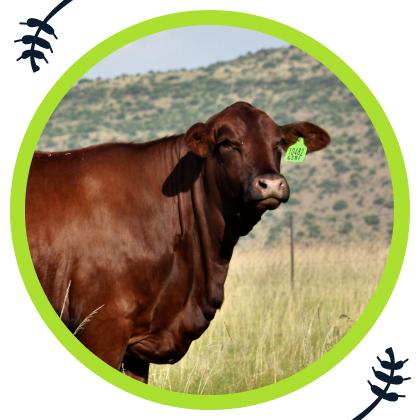

Press statement by Mornay Verster from Le Roc Brangus, Brahman and Droughtmaster
Editor: Suné Bartman (MSc Agric Production Physiology and Product Quality)
Translated by: Tinus Havinga


Twenty-five years of breeding, dozens of trips to breeders from all over the world, numerous visits to South African breeders, and an unquenchable passion for breeding are what convinced me to finally achieve a long-standing goal. This goal was not only to introduce the ideal animal to breeders but also to establish and transmit the criteria that such an animal must meet.
The ideal animal must have excellent abilities in all fields that are of economic importance to you as a cattle farmer; fertility, adaptability, growth abilities, ease of calving, and functionality.
By focusing on this set of characteristics, you can ensure that good growth is converted into profits for you and the customers who purchase animals from you. Twenty-five years ago, I bought my very first Brangus bull, and the enormous difference he made in my herd was immediately apparent. In the first generation, he had already left a significant imprint, and despite the mixed-breed cow herd, the uniformity of the calves produced by the Brangus bull was remarkable. This uniformity and the exceptional growth of the calves convinced me that I was on the right track to create the ideal animal. Shortly thereafter, I selected 25 Brangus-type cows and put them with my Brangus bull, while constantly purchasing top-quality bulls to contribute to my breeding goals. In the first few years, I focused on improving my phenotype, with beautiful polled animals with typical Brangus heads, broad mouths, and good hocks being my main criteria.
New bulls were regularly introduced to achieve this, and as the phenotype improved more and more, I could shift my focus to a new breeding goal - good growth for 200 and 400-day-old animals. At this stage, my main market was the feedlot industry, which means that the heavier the calf, the more profit. The choice to focus on improving my calves’ 200 and 400-day masses was also clearly reflected in the genetic trends of my herd, as received from Breedplan. In addition to this, the selection pressure that has been applied over the past 25 years has led to today’s herd of over 1,000 registered cows, which has maintained an average calving interval of less than 400 days for the past few years. With this milestone achieved, I could move on to a new breeding goal; to produce animals with more skin and increased adaptability, specifically for our commercial breeders who largely practice extensive farming.
Through my own experience, I discovered that animals with more skin produce better, with better capacity and growth abilities. To achieve this breeding goal, we started a polled Brahman herd three years ago. Because the overall goal is more long-term, we registered a separate stud for these Brahman, which is called “Le Roc Poena Brahman” - this stud already consists of about 150 head of cattle, most of which already carry the polled gene. We are working on breeding the white and red lines and are currently using the Brahman on a small percentage of our Brangus herd to achieve the above-mentioned goal. My pursuit of the ideal beef cattle has involved many hours of research, reading and listening. Given the herd I had already built and assembled, I wanted to know if there was anything more I could do to make them even more efficient and profitable.
This led me back to a lecture that Professor Frikkie Neser had given a few years earlier: “...there will no longer be any specific breed, there will only be a red breed.”
Words that were received sceptically at that time, but with which I now wholeheartedly agree. The breeds are so close to identical that even a seasoned breeder would not be able to distinguish them if a group of the breeds were mixed together. The “fancy points” in each breed that can change a bull’s stud rating can often be the cause of top genetics being lost, even though it has nothing to do with an animal’s production abilities. The only “fancy points” that interest me are those that will produce more meat. It is this mindset that finally led me to the Droughtmaster, the cattle breed that would complete the circle and make the ideal beef cattle a reality. I obtained semen from a top-proven Droughtmaster bull that had already sired over 450 offspring and flushed my best Brangus cow with “sexed” embryos. From this flush, 8 beautiful heifers and 1 bull calf were born. These calves exceeded my wildest expectations and as a result, we registered the “ROCMASTER Droughtmasters” stud.
Our Droughtmaster stud stands entirely on its own, and we regularly purchase selectively bred animals that meet our breeding objectives. As with the Brahman, we use specific Droughtmasters on a percentage of our Brangus herd in our quest to breed the ideal beef cattle. The calves that have been born so far have us very excited, and for the next breeding seasons, very specific pairings using all three of our foundational breeds will take place. We also use an intensive embryo program to achieve our goal more quickly. Our aim is to optimize the combination of the genes of these three breeds to breed excellent ROCMASTER cattle: a highly fertile, particularly hardy, low-maintenance type of cattle with good mobility and excellent growth potential.
Our breeding objectives are still strictly adhered to, and no animal is considered a Rocmaster animal just because they meet the phenotypic criteria. If they meet the phenotypic criteria, they still need to maintain a calving interval of less than 400 days and the cow must wean more than 40% of her own body weight. Sentimentality has no place when it comes to profitability, and if they do not meet the criteria, they are summarily thrown out of the selection pool.

Rocmaster is not a breed; I provide my buyers with a specific animal that will complement both their herd and their environment in order to achieve maximum meat production. I hold two production auctions per year, where we focus on the sale of field-adapted animals. Our bulls are being prepared in a large holding camp for our auction. They receive 6-8 kg of Bul-C per day during the last 2 months before the auction, and the rest of the time they graze and forage. This way, their rumen stays active and we can guarantee their adaptation to any place in South Africa. During our auction, the bulls are in good enough condition for buyers to see what the animals can offer, but they are not overfat and are still accustomed to grazing.
Our entire herd is also available for flushing embryos from cows or for semen collection from any of our bulls. We are also in the process of using our older cows to breed with buyer-specified bulls, and then selling the pregnant cows. This way, breeders who want proven genetics can obtain them without paying a fortune. If I had to start the whole breeding process over, I would have taken a completely different approach. I would have started with top-quality animals, even if it meant I had to be satisfied with fewer animals for the same initial expense. It is a very long process to breed better animal genetics, but with embryos and artificial insemination, you can quickly multiply top-quality animals, and the genetic leap is enormous!
Rocmaster...where breeding is our passion and excellence is our goal! Rocmaster...tough as a Roc Let’s get Roc’ng!


