


Simply Braford: More meat, less hassle
“one of the best-kept secrets in the beef cattle industry”
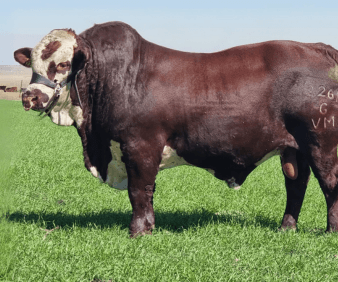

“one of the best-kept secrets in the beef cattle industry”
An animal with exceptional characteristics; one that’s fertile, adaptable, and efficient, giving you more beef for less input…The Braford. Considered “one of the best-kept secrets in the beef cattle industry”, the Braford is a composite breed of beef cattle that originated somewhere in the 1940s. Beef breeders of the time in Australia and the United States needed an animal that could consistently and efficiently produce a uniform, high-quality product in challenging production environments. Accordingly, they shaped this exceptional animal from two well-known breeds of beef cattle.
The Hereford, which was used as the basis for the cross, was an obvious choice due to its worldwide popularity for having excellent fertility and meat quality in both extensive and intensive conditions. When combining these characteristics with the longevity and outstanding mothering abilities of the Brahman, these breeders ended up with a winning combination!
The blend of Hereford and Brahman genetics allowed this synthetic breed to adapt, thrive, and reproduce in diverse environments. Between then and the 1960s, the Australian Braford Society and The International Braford Association were formed to represent breeders of this extraordinary new breed in Australia and the United States of America. But this was only the beginning of the Braford’s journey…only a few years later, this breed would be further developed by dedicated South African breeders, perfectly tailored to thrive under the unique conditions of the country.
Origin
In the mid-1970s, two visionary cattlemen - Flip de Jager from Ladysmith and Naudé Bremer from Rosendal – had the brilliant idea of establishing the Braford in South Africa, after which they independently developed the SA Braford. Both of these men made use of registered Hereford and Brahman animals in sound breeding programs to keep with a worldwide animal breeding endeavor: to combine the favorable characteristics of two breeds in order to produce a synthetic breed with greater productivity than either of the parent breeds.
“...the Braford breed is widely adaptable, thriving in a range of climates...”
As the SA Braford was continually advanced throughout the following years, the SA Braford Breeders Society was registered as a developing breed with the SA Stud Book on the 30th of May 1997. The SA Braford Breed Society is the seventh member of the World Braford Confederation, joining countries such as Australia, America, Argentina, Uruguay, Brazil, and Paraguay. This diverse membership demonstrates that the Braford breed is widely adaptable, thriving in a range of climates from semi-desert to sub-tropical.
About the breed
The SA Braford breed is particularly recognized for its early to medium maturity, a quality that sets it apart within the beef industry. This characteristic means heifers reach puberty at a younger age, while steers can be finished quicker and with more efficiency – on either pasture or in a feedlot – requiring less feed overall. Biological performance tests conducted by the Agricultural Research Council as part of Phase C bull tests have likewise consistently highlighted the breed's remarkable feed conversion ratios compared to other beef breeds. This advantage becomes particularly crucial during periods of grain shortages or high grain prices, where animals can be finished efficiently on minimal grain, offering substantial economic advantages to feeders. Notably, in the years 2003 and 2004, the SA Braford also excelled in the East Freestate Field Bulls Test under extensive field conditions and continues to demonstrate outstanding performance today.
Key Attributes
The SA Braford breed is furthermore also valued for several key attributes. Fertility stands as paramount, with a selection focusing heavily on achieving optimal inter calving periods, currently averaging 368 to 375 days among top Breedplan cow herds, with a broader societal goal set at 400 days. Braford bulls are furthermore known for their exceptional libido and are strictly selected based on scrotal circumference.
The genetic blend of Hereford and Brahman genes has equipped the Braford with remarkable adaptability, enabling it to thrive in diverse climates—from extreme heat to cold, as well as very wet to very dry environments—while also showing resistance to South African diseases. The breed's versatility is evident in its successful operations across nearly all South African provinces.
Additionally, breeders have established themselves in Namibia and, more recently, also in Mauritius. Its medium-sized body frame makes the Braford extremely efficient, with the ability to efficiently utilize low-quality grass while yielding weaner calves with average weights of 45-50% of the cow's weight. The average birth weights of 30-36kg and weaning weights ranging from 200-270kg demonstrate the efficiency of the Braford breed. This efficiency was further proven during the Eastern Free State Veldbulklub tests when these animals achieved high Average Daily Gains of between 626-752 grams on veld grass. In intensive feeding environments like feedlots, Brafords can achieve impressive daily weight gains of up to 2kg, reinforcing their reputation as efficient producers in varied agricultural settings.

Qualities & Traits
Like the Hereford, the Braford is red with a white underbelly, head, and feet, while getting its robust build from the Brahman. Though primarily used for beef production, the Braford is occasionally used for rodeos in countries where the sport is big. Known for their heat and insect resistance, Brafords thrive best in warm climates, despite their sometimes-irritable temperament. Their exceptional maternal abilities have long been recognized and celebrated, including early puberty, high fertility, ease of calving, optimal milk production, strong maternal instincts, and lasting productivity. These qualities have earned Braford females a distinguished reputation in the beef production industry. Breeding Braford bulls with adapted purebred or crossbred cows enables cattlemen to produce outstanding replacement females that benefit from Braford's superior maternal traits.
Unlike terminal sires, Braford bulls are selected to maintain growth rates without undesirably increasing mature size, thereby ensuring they remain functional and adaptable in diverse agricultural conditions. By steering clear of the "bigger is better" trend prevalent in purebred cattle breeding, Braford breeders have sidestepped related challenges such as difficult calving and overly large market steers.
SA Braford recommends three methods for producing the South African Braford through crossbreeding programs:
In the first method, a Hereford cow is bred with a Brahman bull, resulting in offspring with a genetic makeup of 50% Hereford and 50% Brahman. If the offspring is a heifer, she is then mated with a full Brahman bull, producing a calf that is 25% Hereford and 75% Brahman. This calf is subsequently bred with a full Hereford bull to yield a calf that is 62.5% Hereford and 37.5% Brahman.
In the second method, a purebred Hereford cow is crossed with a full Brahman bull, resulting in a 50:50 Hereford-Brahman hybrid. This hybrid calf is then bred with a Hereford bull to produce offspring with 75% Hereford and 25% Brahman genetics. Finally, this calf is mated with a Brahman bull to yield offspring with 37.5% Hereford and 62.5% Brahman genetics.
In the third and final method, a non-black beef-producing breed is crossed with a Braford bull, resulting in offspring with 50% of each breed's genetics. This offspring is then bred with a Braford to produce a calf with 25% of the other breed's genetics and 75% of Braford's genetics. Subsequently, this calf is bred with a Braford to produce offspring with 12.5% of the other breed's genetics and 87.5% of Braford's genetics. Finally, this offspring is bred with a Braford to produce calves with 6.25% of the other breed's genetics and 93.75% of Braford's genetics.
“...Braford breeders are dedicated to consistently producing cattle that thrive in the demanding conditions faced by commercial cattlemen.”

By using these methods, breeders can systematically enhance the genetic diversity and resilience of the South African Braford, ensuring its continued adaptation and improvement for future generations. In conclusion, Braford breeders are dedicated to consistently producing cattle that thrive in the demanding conditions faced by commercial cattlemen. The exceptional growth rates of Braford weaners, whether on natural veld or in feedlots, underscore their remarkable potential and adaptability.
Coupled with the breed’s superior feed conversion efficiency, these traits provide significant benefits for beef cattle enterprises. Ultimately, the Braford breed represents a well-rounded and highly profitable choice in the cattle industry, ensuring its continued success and prominence.


