


Stress Management Strategies for Wheat
“...Wheat is also a metaphor for growth, hard work, love,

“...Wheat is also a metaphor for growth, hard work, love, and charity...”

Introduction
Wheat (Triticum aestivum) is an ancient crop with a rich and deeply rooted history, as archaeological records have uncovered evidence that wheat was first cultivated in 9600 BC. It is one of those few crops that have driven away hunger and famine, as it is a staple cereal grain crop cultivated worldwide for its seed. It symbolizes development, advancement, and abundance, as well as being seen as a sign of wealth and currency. Wheat is also a metaphor for growth, hard work, love, and charity, and is one of the most mentioned crops in the Bible.
However, climate change has put pressure on wheat on a global level, and in recent years the crop has come under fire in South Africa as well. Extreme weather conditions have caused reduced yields in both the irrigated and dry land areas and may even be seen as a high-risk and unpredictable crop as a result. Kynoch has therefore developed scientific strategic management strategies to help maintain and increase yields despite the stressful environmental conditions.
Stress Management Practices for Weather-Sensitive Wheat
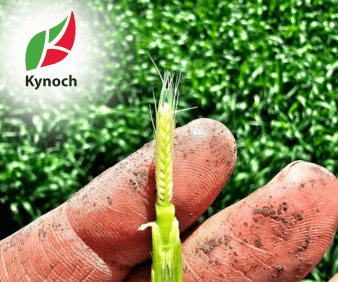
Wheat is often seen as a strong, hardy, and tough crop, which is true for the most part. It produces a well-developed fine root system that can penetrate and utilize the soil more successfully than other crops, such as maize. Wheat is a small grain crop that prefers cool weather and is adapted to winter conditions for the initial vegetative phase. Yet, there are critical stages within its life cycle that are very sensitive to stressful extreme weather conditions. The flowering and grain-filling stages are particularly sensitive to extreme heat, cold, and drought conditions. The self-pollinating, intricately beautiful, and delicate wheat flower (photo) has an optimal temperature of 23°C with a low tolerance level of ±1.75°C during anthesis and pollination. The optimal temperature during the vital grain filling period is 26°C, with an even lower tolerance level of ±1.53°C. Dubey et al., 2020, stated that terminal heat stress in wheat occurs when mean temperatures during the grain-filling stage exceed 31°C. Studies further show that yields can decrease by a significant 18.1% as a result of terminal heat stress during the pollination and grain-filling phase. In the irrigation areas of the Northern Cape, we often experience temperatures over 40°C.
There are various basic agronomical practices such as planting date, cultivar, seed depth, seeding rate, soil tillage, seedbed preparation, pest management, soil water scheduling (irrigation), and salinity control, to name a few management options that can be used to mitigate these environmental challenges. Fertility and nutrition only come into play once these other boxes have been checked. It is important to remember that the potential must first be created, and only then can the fertilizer maintain that potential. Technology-driven granular planting and topdressing products such as KynoPlus®, Miracle™, CASUMA®, and the ULTRA® ranges can be used to provide a stabilized nitrogen supply with reduced losses, an improved potassium source with additional zinc and silicon, additional stress-relieving secondary elements, and essential micro-elements, respectively, to enhance the potential even further. A healthy plant will handle the stress much better, so give the crop a fighting chance from the beginning.

Kynoch Stress Solutions
Heat stress, as with any other form of stress, will produce reactive oxygen species, also known as free radicals. These unstable oxygen molecules can cause havoc on living plant cells. They disrupt the integrity of the cell, resulting in leaky cells. Photosynthesis is one of the most important processes in the plant that is directly and severely negatively affected by stress. Within Kynoch’s vast high-quality product range, a few specialised products are formulated with scientific stress management strategies in mind. Some products that stand out are Kynoch Wheat OEMFF®, KYNOFULVATE YELLOW®, and KYNOKELP®. These products are designed to enhance and stimulate the photosynthetic rate on a physiological level. These products can be used individually but are also compatible and can be used in combination with each other for improved results. Wheat OEMFF® is a foliar product that contains a perfectly balanced nutrient combination along with a specialized enhancer that stimulates the photosynthesis process. Wheat OEMFF® can be applied early in the season during the vegetative phase and later at the vital flag leaf stage.
The flag leaf is the most important leaf on the wheat plant, and it is imperative to protect this leaf by using Wheat OEMFF®. KYNOFULVATE YELLOW® can be used with foliar products such as Wheat OEMFF® or with liquid fertilizers as an uptake enhancer and to mobilize nutrients within the plant and soil. Other advantages of KYNOFULVATE YELLOW® include the ability to increase the drought tolerance of the crop during water-stressed conditions. Lastly, KYNOKELP® is a natural product that contains many beneficial plant bio-stimulating compounds. This product works on a hormonal level to stimulate root development, which is particularly important as stress is detrimental to root growth. There are other additional organic and inorganic molecules that occur naturally in KYNOKELP® that activate other metabolic processes and functions that can alleviate stress. These products form part of the KYNO STRESS KIT concept used to manage crop stress and therefore increase yields and quality.
Conclusion
Wheat is still the best crop since sliced bread, and an article published on 4th May 2020 in Times Now News referred to wheat as an “auspicious grain crop!” Wheat is still seen as a favorable cash crop that has the potential to bring prosperity and is seen as a sign of future agricultural success. Therefore, in an ever-changing climate, the emphasis and focus for Kynoch is on controlling what we can, and that is to mitigate and manage stress as effectively and extensively as possible on an agronomical and plant physiological level. Kynoch is constantly striving to be solution-driven to keep our farmers successfully farming.
For more information, contact Kynoch:
jason.sparrow@kynoch.co.za


