


The goat: Friend or foe in the ongoing battle against bush enroachment?
Bush encroachment… For any farmer who has ever made

Bush encroachment… For any farmer who has ever made their living off grazing animals, these words have a very obvious and unconcealed significance: declining grazing capacity, higher feed inputs and lower profit. This infamous ecological process entails a shifting from grass-dominated vegetation to wooded vegetation, ultimately declining the grazing capacity to such an extent that a previous economically viable livestock property is no longer feasible. Thus threatening not only the livelihood of the farmer, but on a larger scale also risking food security and the existence of the grassland biome. The global importance of grasslands is shown by their extent; they comprise about 26% of earth’s total land area, and 80% of all agricultural productive land. In South Africa, the grassland biome is the second largest biome, subsequent only to the savanna biome.

Both grassland and savanna regions are of great agricultural importance, providing the feed base for grazing and browsing livestock, thereby also contributing to the markets based on livestock derived products such as fertilizer,
transport, fibre and leather.
Both biomes, however, are also threatened by the advancement of bush encroachment. Before land was divided into farms and managed by farmers, this phenomenon had always been controlled by natural occurring hot fires as well as herbivores. Removal of both these factors to accommodate grazers, in combination with overgrazing - which weakens the grasses to such an extent that they are unable to withstand competition - and poor management practices, resulted in the continual progression of encroachment. The woody species compete with the existing, potentially overgrazed grass species for natural resources, suppressing and reducing any further foliage development and thus decreasing the potential grazing capacity of the encroached area. Considering everything mentioned above, addressing this issue is of utmost importance for every farmer affected by it.
The question now, is by what means?
Many approaches have been attempted in the past, all showing relatively insufficient results: controlled fires, aimed at encouraging grass regrowth, are neither hot, nor intense enough to adequately stunt seedling growth. Manual means by labour is too time consuming to really be effective, and mechanical methods by machine, just not economical. Even chemical control was put to the test, and although it shows promise in restricting further growth of woody species, it is just too expensive for the everyday farmer to consider, and also poses a threat to the health of livestock if accidentally consumed.
So, what about the goat?
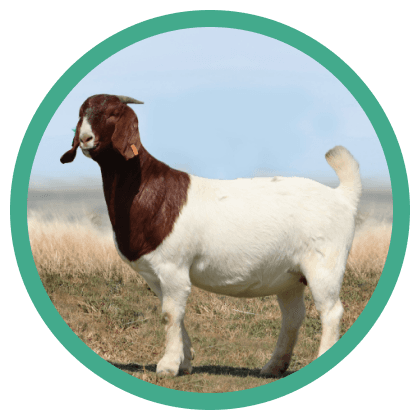
Goats can be considered a biological method of bush control, yet the wide belief that goats are destructive to their surroundings due to diminishing the biodiversity and excluding other ungulate species, have limited the popularity of using them as a control method in the past. Recently, however, studies have suggested that goats can do more good than harm if properly managed. In a study done in the False Thornveld in the Eastern Cape, the effect of continuous browsing by goats on the bush clump density, structure and species composition was conducted. Researchers wanted to establish whether goats have any influence in long term bush development, and if they have potential as biological control methods. What they found was that species composition was relatively unaffected by browsing activities, with a higher tendency towards increased, rather than decreased biodiversity, contradicting the theory that goats are destructive to their surroundings.
Frequency, height as well as canopy- and ground diameter of bush clumps were shown to have declined in browsed areas, as opposed to un-browsed, controlled areas. Overall, horizontal and vertical growth was seen to be stunted in areas where goats were allowed to browse at stocking rates intended for bush control. Stem densities were shown to have increased in browsed areas, but this had no effect on the abundance of the herbaceous layer. Overall it was found that the bush density, as it were before goats were introduced, has not decreased or increased by browsing activities. However, the rate at which densities increased were drastically reduced. It was also evident that, in addition to browsing, trampling by goats aided in the deceleration of bush encroachment, opening up ground covered by bush, and thereby permitting for improved grass growth.
To browse or not to browse?
The question that now arises is whether implementing this method would be the practical option, and if so, how to go about it? Goats can definitely be considered a practical and cost effective way of managing bush encroachment, but the treatment required will all depend on the degree of encroachment in the different areas or different grazing units. If encroachment has progressed to an unmanageable extent, browsing alone would not be sufficient to significantly repress the aforementioned. Preceded, intense burning would be required, followed by a sound browsing plan. However, in cases where encroachment has not meaningfully affected the grazing capacity, browsing alone would be adequate in controlling further expansion thereof. Altogether, browsing can be reflected as a cost effective, non-destructive and proficient means of managing the ever present occurrences called bush encroachment.


