


The Kalahari Reds: an Origin Story
By: Suné Bartman(MSc Agric Production Physiology and Product Quality)
By: Suné Bartman
(MSc Agric Production Physiology and Product Quality)


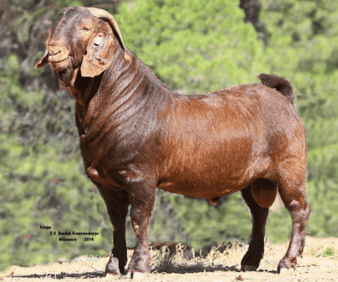
From the red dunes of the Kalahari Desert in Southern Africa, an indigenous goat breed with striking qualities, unique characteristics, and excellent abilities came to exist. The Kalahari Red goat - is a breed renowned for its striking red coat, its astonishing adaptability to harsh environments, and its fascinating origin story. Since its humble beginnings, the Kalahari Red has become more and more popular, and is today regarded as a critical meat goat breed in South Africa, Namibia, Australia, and even some parts of America.
In the early 70s, a Boer Goat stud breeder from Tshipise – known as Mr Ben Vorster – made a curious discovery regarding one of his 200 stud ewes; each year when she lambed, she produced one lamb typical to the Boer Goat phenotype, and one lamb that was completely red. The differences among these lambs became more apparent, and proved to be more than skin-deep, as they grew and reached maturity. Intrigued by this, Mr Vorster (and, unbeknownst to him at that time, a few other South African goat farmers) decided to collect as many of these red and red-dappled lambs as they could and then breed with them. These animals came from diverse herds across the country and even from as far as Namibia, with some originating from native land races and others being solid red Boer goats. The goal was to create better herds with consistent red color, fecundity, and strong maternal instincts. Natural selection played a pivotal role in the development of these animals, allowing only the toughest ewes to continue the breed's lineage.

Among these farmers was Albie Horn of the farm Hartebeeshoek in De Aar. He recognized the remarkable qualities of brown goats early on and painstakingly built his flock by sourcing them from various regions, including the former Bophuthatswana, the Eastern Cape, the Karoo, and Namibia. Albie Horn's visionary approach didn't, however, just stop at breeding; he was determined to elevate the brown goat's status to that of a registered breed. Albie placed a lot of emphasis on the exceptional mothering abilities, the robust nature, and the adaptability of these brown goats, particularly in the challenging Kalahari Desert environment where he farmed. Moreover, he saw the potential for brown goats to enhance not only South Africa's indigenous goat breeds but also those found in Australia. By breeding for uniform coloration, he contributed to the breed's genetic consistency and laid the foundation for the future success of the red goat.
In 1994, Tollie Jordaan – a renowned Boer goat farmer of the farm Grootvlakte in the Eastern Cape – received a visit from an American exotic animal importer, Jurgen Schults, who advised him to start breeding with brown goats. Taking this to heart, Tollie set out and purchased 8 brown goats for his herd. Despite his initial disappointment with the head and body conformation of these animals, Tollie soon realized that the fecundity, mothering traits, and adaptability of these animals were exceptional. As good breeding rams were quite scarce during this time, Tollie extended his search to Namibia, where he found valuable genetic material that allowed him to excel in his breeding endeavors.
One other greatly recognized and experienced small stock farmer from the Northern Cape, Louis van Rensburg, came across a type of goat called the “Solid Reds” upon his visit to America. This encounter convinced him to start breeding with his line of brown goats, and after returning to South Africa, Louis did just that. He used one of the brown Boer Goat rams from his herd to breed with ten Boer Goat ewes in the hopes of creating red offspring. Unfortunately, not one of the offspring from that breeding season resulted in a red or dappled lamb and so the next breeding season, Louis placed these animals back with their father, resulting in all-brown offspring. In just a few years, he had 120 beautiful brown lambs in his herd.
On June 28, 1996, a highly intrigued Louw Pretorius of a well-known agricultural magazine, came to know about the unique red ewes bred by Ben Vorster and decided to write an article about them. Following the publication of this article these farmers, who had been previously unaware of each other, started joining forces, united by their shared goal of developing this superior breed of red goat. This pivotal moment in communication and awareness among the farmers laid the foundation for further advancements in the development of the breed that would later be called the Kalahari Red.

In their pursuit of recognition for the Kalahari Red goats as a distinct breed, the breeders took a significant step in 1998 by showcasing their animals alongside Savanna breeders in Bloemfontein, where they presented their goats as "Brown Savannas." This event marked a crucial milestone in their journey, fuelled by the aspiration to establish the red goats as a separate breed in their own right. To do this, DNA tests were required to determine if there was sufficient genetic separation between the Boer goats, Savannas, and these so-called “Brown Savannas”. In 1999, the breeders came together to establish a dedicated club for their new breed, settling on the name "Kalahari Red", which drew inspiration from the renowned Kalahari Desert and signified the breed's Southern African origins. That same year, multiple farmers in Australia imported embryos from South African Kalahari Red breeders and implanted them into recipient ewes on Australian soil. This marked the expansion of bloodlines across the country, ultimately leading to the thriving national herd they have today.
Skepticism regarding the genetic differences between Kalahari reds and Boer goats was quite high then, with certain individuals assuming that the Kalahari Reds were merely a closely related form of Boer goats, primarily due to their Boer-like appearance. However, results from the DNA samples that were submitted soon disproved this misconception. In 2004, Dr. Marida Roets, conducting research at the Agricultural Research Council in South Africa, definitively established that these red goats were a unique breed with their own distinct DNA markers. This groundbreaking research helped dispel any doubts about the breed's identity, revealing a greater genetic difference between the Kalahari Reds and Boer goats than between Boer goats and African Savanna goats.
Breeders such as Louis van Rensburg and Ben Vorster, who had harbored concerns about their breeding programs stemming from Boer goats, were relieved when the conclusive test results affirmed the Kalahari Red goat's unique genetic identity. These findings solidified the Kalahari Red as a distinct breed, separate from its Boer goat counterparts, and paved the way for its continued development and recognition within the global farming community.
Since its establishment in 1999, the club was self-managed up until October 19, 2004, when a pivotal decision was made: during an Annual General Meeting, members of the club decided to merge with the South African Boer Goat Breeders' Society. Fast forward to 2012, thirteen years later, and the Kalahari Reds have flourished. With 79 registered stud breeders and numerous commercial breeders, they have become integral to the meat goat industry in South Africa and abroad. This growth can be attributed to their active participation in shows, sales, and the collaborative efforts of clubs across the country.
These achievements were driven by an unyielding passion for breeding excellence, focusing on key attributes such as fecundity, mothering traits, adaptability, and conformation—a testament to the essence of the breed pioneers such as Tollie Jordaan, Albie Horn, Louis van Rensburg, and Ben Vorster, who envisioned the breed, nurtured the breed, and – in their own famous words – kept it pure, kept it natural, and kept it Kalahari Red.


