


The Significance of Ticks in South Africa: The African Blue tick
Over the last couple of years, the occurrence of

Over the last couple of years, the occurrence of ticks in South Africa, and the impact they have on the livestock industry, has greatly increased. This increase is attributed to factors such as changes in rainfall patterns, higher pre-winter temperatures in certain areas, as well as tick resistance to chemical dips – a factor widely regarded as the greatest contributor to the escalation. The Asian blue tick and African Blue tick are arguably the best-known ticks in the world and in Southern Africa respectively. Previously known as Boophilus microplus and Boophilus decoloratus, their taxonomic reclassification to Rhipicephalus (Boophilus) microplus and Rhipicephalus (Boophilus) decoloratus (Rh. (Bo.) decoloratus) in 2003 marked a pivotal moment in tick taxonomy. Of the seventy species belonging to the Rhipicephalus genus, thirty-two are found in Southern African countries. With such a diverse presence in the region, we will take a closer look at the indigenous African Blue tick, discussing its identification, distribution, and lifecycle, as well as the ecological significance of the African Blue tick in South Africa.
Of the seventy species belonging to the Rhipicephalus genus, thirty-two are found in Southern African countries.

Identifying the African Blue tick
The African Blue tick presents itself as a species of small and inconspicuous ticks, characterized by its slender legs and short mouthparts. In appearance, the males exhibit a brownish-yellow hue, with the darker gut visible through the moderately sclerotized scutum of the females. Engorged females, on the other hand, display a distinctive bluish-brown coloration. Notably, males are often encountered in pairs with females. The tick's morphology is further defined by its short mouthparts and unique teeth arrangement, featuring two columns with three denticles in each row.
Additionally, the scutum of males and the scutum of females are adorned with setae, while lacking festoons. The basis capituli, hexagonal in shape, contributes to its distinct appearance. Despite the challenges posed by their diminutive size, the tick's intricate features, including the presence of fine hairs and grooves on the scutum, contribute to their remarkable adaptability and survival in various habitats.
Distribution
The African Blue tick is distributed nearly all over South Africa, primarily favoring areas with ample moisture and warmth. With a remarkable adaptability to different environments, this tick species has been successfully collected in savanna, fynbos, and grassland biomes throughout the country. It can be found along the coastal regions of the Western and Eastern Cape Provinces, extending through KwaZulu-Natal, Mpumalanga, Gauteng, Limpopo, and the Northwest Provinces, as well as the eastern portion of the Free State. This tick species thrives in the wetter regions of South Africa, although it is absent from drier areas receiving less than 380 mm of annual rainfall, such as the western Free State, central Karoo, Bushmanland, and little Namaqualand. Despite its preference for moisture, Rh. (Bo.) decoloratus also inhabits colder mountainous areas, including the Drakensberg range and parts of Lesotho.
While it is limited in arid territories like Namibia and Botswana, it maintains localized populations in regions with higher rainfall. Additionally, Rh. (Bo.) decoloratus extends its range into neighboring countries such as Zimbabwe, Angola, Zambia, Malawi, Tanzania, Burundi, Uganda, Kenya, and Ethiopia, particularly in areas with wetter highlands and sub-highlands. Its adaptability and wide distribution make it a significant presence across various ecosystems in sub-Saharan Africa.


Life Cycle
The life cycle of the African Blue tick is rather fascinating and highlights how well adapted it is to its environment. As a one-host tick species, Rh. (Bo.) decoloratus larvae will complete all stages of their life cycle on a single host animal. This process begins when an engorged female detaches from its host and lays between 1,000 to 2,500 eggs one week later in nearby vegetation. These eggs typically hatch within 3 to 6 weeks, giving rise to larvae that climb the vegetation to the top, and patiently await a suitable host. Once attached, the larvae take about one week to engorge and molt into the nymphal stage. Following this, the nymphs re-attach to the host, engorge, and molt into adults within another week. Once again, the adult ticks will re-attach and mate, after which adult females fully engorge before dropping off the host to restart the process. This entire lifecycle, including the non-parasitic phase, lasts about two months, enabling numerous cycles to be completed in a single year.
In warm enough regions, ticks are active throughout the year, with activity peaking during the spring and again in late summer and autumn. Particularly noteworthy is the synchronous hatching of larvae in spring, leading to large numbers of ticks on vegetation and hosts, while activity may decrease in cooler regions during the winter months.

Hosts and Attachment Sites
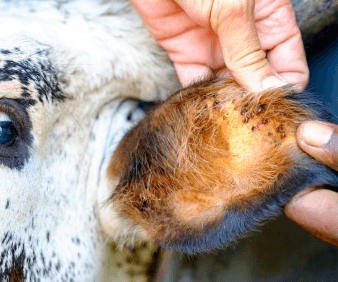
The African Blue tick exhibits a definite preference for cattle as its primary host, however, it also parasitizes a range of other animals such as impalas, eland, nyalas, bushbuck, greater kudu, horses, and zebras. Typically, these ticks attach themselves to the sides of the body, shoulders, neck, and dewlap of their hosts, however in heavily infested animals ticks will attach all over. Additionally, immature stages may be found on the tips and upper edges of the ears, as well as on the legs.

Diseases Transmitted
The African Blue tick is notorious for transmitting two of the most important tick-borne diseases in South Africa, namely African babesiosis (African Redwater) and anaplasmosis (Gallsickness). Specifically, it transmits Babesia bigemina – the causative agent of babesiosis – to cattle. This transmission occurs during the nymphal and adult stages of the tick's life cycle after the pathogen has passed transovarially (from the female tick to her eggs, ensuring that the offspring are already infected when they hatch) from one tick generation to the next. The incubation period for babesiosis in cattle is typically 12 to 14 days. Once established in the tick host, B. bigemina can be transmitted by successive generations of ticks without the need for acquiring new infections. Moreover, Rh. (Bo.) decoloratus also transmits Anaplasma marginale to cattle, and Borrelia theileri, which causes spirochaetosis, to cattle, sheep, goats, and horses.
Prevention and Control
Given their preference for cattle and exposure to multiple treatments during their relatively short life cycle, blue ticks are prone to developing resistance to acaricides. Therefore, effective treatment early in the rainy season is crucial to prevent a buildup of tick populations in late summer, which can become challenging to control. Under optimal conditions, the life cycle of these ticks can be completed in just two months, potentially resulting in four generations per year. To address high tick challenges or when animals are moved to rested camps, strategic and frequent dipping of animals is recommended. Treatment strategies often include early spring treatments to target larvae and nymphs, followed by contact dips when endectocides are used. Additionally, dipping animals once a week for three weeks, following the 5, 5, 4 day.
Conclusion
For as long as humans have kept livestock, the fight against ticks and tick-borne diseases has bravely been fought by stockmen all over the world. This is even more true in South Africa, where the convergence of favorable climatic conditions, diverse host species, and high tick prevalence creates the perfect environment for tick abundance. Understanding key aspects of the African Blue tick—its habitat, lifecycle, distribution, and preferred hosts—is paramount for implementing effective prevention and control strategies that could limit the devastating economic effects of these ectoparasites. Despite advancements in tick control methods, the persistent threat of tick-borne illnesses highlights the ongoing need for vigilance, proactive measures, and informed decision-making. By doing this, farmers can mitigate the detrimental effects of the African Blue tick on livestock health and productivity, safeguarding the long-term sustainability of livestock production.


