


The South African Boer Goat
South Africa, although a relatively minor player in the


South Africa, although a relatively minor player in the global goat industry, takes immense pride in its unique and valuable livestock breed - the Boer goat. Despite possessing only around 3% of Africa's goats and less than 1% of the world's goat population, South Africa's Boer goats have gained widespread recognition for their exceptional qualities and contributions to the agricultural sector.
“...over the years, the Boer goat has evolved into a highly productive and valuable breed.”
The Boer goat is a breed deeply rooted in the history of South Africa. It is believed that goats were already present in the region when European settlers arrived, and over the years, the Boer goat has evolved into a highly productive and valuable breed. The Boer goat's story begins with a rich history of evolution in Southern Africa, combining indigenous African and introduced European stock. Over the years, careful breeding and refinement efforts have led to the development of a breed highly regarded for its meat productivity, high fertility rates, fast growth, and adaptability to diverse climatic conditions.
Origin
Boer goats have a fascinating origin, evolving in Southern Africa from a mix of indigenous African and introduced European stock. Barrow (1801), Pepler (1886), Schreiner (1898), Epstein (1972), and other researchers have tried to describe and explain the origins of the Boer goat and how it got to South Africa. While goats were already present when the European settlers arrived, it is believed that they might have originated from various regions, including Europe, India, Egypt, and Nubia. The routes from North Africa to South Africa were likely along the west and east coasts, which allowed for the movement and mingling of different goat types.
“...Van Rensburg classified the goats found in South Africa into three main groups: milk goats, Angoras or silky goats, and Boer goats.”
The first encounters of the Boer goats by European settlers were around 1661 in the vicinity of present-day Clanwilliam, where they were kept by the Namaquas. The Namaquas claimed that these goats belonged to the Batlapin clan in Botswana. The breed gradually gained popularity, and the import of milk goats from Switzerland and Germany in the early 20th century further contributed to the establishment of a more refined Boer goat breed, representing a variety of types. In 1938, Van Rensburg classified the goats found in South Africa into three main groups: milk goats (pure imported breeds), Angoras or silky goats, and Boer goats. Boer goats were further classified into various sub-types, including the Common Boer goat, the Coat of Long hair Boer goat, and the Long-Haired and Polled Boer goat.
Form & Build
“...The Common Boer goat is a compact, fine-quality, short-haired goat with a regular build.”
The Common Boer goat is a compact, fine-quality, short-haired goat with a regular build. It has become popular among butchers for its skin and meat, as it is a fast-growing breed that can be slaughtered at a young age. Boer goat ewes are also known for giving ample milk, making them popular in certain regions. Sub-types of the Common Boer goat include the Dappled Boer goat, the Brindle Boer goat - with distinctive yellow and brown patches - the Underdeveloped Ear Boer goat, characterized by small, underdeveloped ears, and finally the White Boer goat, which may have a brown neck and head.

The Long-Haired and Polled Boer goat type was obtained through cross-breeding with imported milk types. It has a light, fine head without horns, long ears, and the build of the milk type. Most Boer goat flocks are a mixture of these types and can be challenging to classify accurately. The Coat of Long Hair Boer goats has heavy characteristics, including a heavy head, heavy horns, coarse legs, and coarse meat. The long hair covers the hindquarters or the entire body, and these goats can only be slaughtered when fully grown and in good condition.

In the past, little attention was paid to the breeding of Boer goats, but some progressive farmers began to focus on selection and breeding, especially in districts with intensive cultivation. These farmers worked to establish standards for Boer goats to improve the breed's economic value. They collected data from farmers, buyers, and butchers to develop a point scale for Boer goats, which later formed the basis for the refined Boer goat point scale used today.
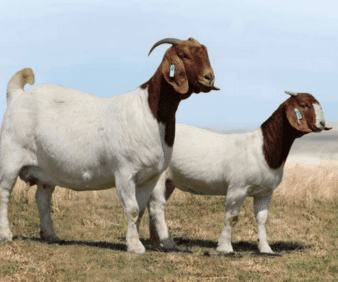
The Boer Goat Breeders' Association of South Africa established breeding standards for Boer goats, focusing on traits of conformation, head, neck and forequarters, barrel, hindquarters, legs, skin and covering, and sexual organs. A strong head with large brown eyes and well-fitted jaws, along with prominent curved horns, characterize this breed. The neck should be moderate in length, well-fleshed, and joined to the forequarters seamlessly. A long, deep barrel with well-sprung ribs and a fairly straight back are ideal. The hindquarters should boast a broad, long rump and well-fleshed thighs. Strong and well-placed legs signify hardiness. A loose, supple skin with pigmented eyelids and hairless parts is essential, along with short, glossy hair.
Ewes should have well-formed udders with functionally effective teats. Rams require two reasonably large, healthy testes in one scrotum. Size-wise, the ideal Boer goat is an average-sized heavy goat, emphasizing meat production. These breed standards dictate a distinct appearance with white color, redhead, and blaze, as well as pigmented skin and good conformation. These standards are used to judge Boer goats at shows and auctions and aim to promote the development of high-quality and economically valuable Boer goats.
“...renowned for their exceptional meat productivity, high fertility rates, rapid growth, and adaptability to various climatic conditions.”
Boer goats are renowned for their exceptional meat productivity, high fertility rates, rapid growth, and adaptability to various climatic conditions. They serve not only as meat producers but also shine in show competitions. Their hardy nature and ability to graze on diverse plants and grasses make them invaluable in combatting bush encroachment. Additionally, they have low water turnover rates and are less prone to internal parasite infestations. The ewes exhibit early breeding capabilities and can be synchronized for optimal breeding. However, special attention must be given to preventing Anaplasma ovis infection, which can cause reproductive issues. Boer goats also produce good quality milk with high protein and fat content. The ram’s libido and semen quality vary seasonally, necessitating careful breeding management. To ensure the future success of Boer goats, performance testing is essential, measuring economically important traits that will guide their continued prominence in the farming industry.
As with any livestock, nutrition is a vital aspect of Boer goat management, and their diet is similar to other domestic goat breeds. They enjoy leaves, corn, green grass, and supplemental feeds. While show goats require a substantial amount of nutritious food due to their size, medium-sized goats are preferred for commercial production as they are easier to maintain and have lower food requirements. Careful nutritional management is crucial for the overall health of Boer goats. Ensuring they have access to sufficient clean and fresh water is essential since they consume a significant amount of water daily. In terms of breeding, most farmers prefer purebred Boer goats. Additionally, crossbreeding Boer goats with other popular goat breeds can yield highly productive offspring. Some well-known breeds the Boer goat was crossed with include the Spanish, Angora, Kiko, Nubian, Osmanabadi, Jamunapari, and Sirohi goats, all of which produce quality and productive offspring.

The Boer goat stands tall as a symbol of South Africa's agricultural excellence and ingenuity. With its impressive meat productivity, adaptability to various environments, and high fertility rates, this breed has emerged as a valuable asset for farmers. The diligent efforts of early pioneers and breeders have resulted in a goat breed that is not only a top choice for meat production but also holds its ground in show rings. As South Africa continues to embrace the potential of its livestock industry, the Boer goat remains a key player in meeting the nation's agricultural demands. Its ability to graze efficiently, combat bush encroachment, and provide high-quality meat and milk, positions it as a prized breed for both commercial and subsistence farmers. The future of the Boer goat lies in the hands of passionate breeders and farmers who continuously strive to enhance these animals and their economically important traits. By preserving the breed's unique characteristics and promoting sustainable practices, the Boer goat will undoubtedly continue to flourish and make a lasting impact on the country's livestock sector.


