


The Unfaltering Legacy of the reliable Nguni
Watch the YouTube video! The success of Exsteen Ngunis begins


Watch the YouTube video!
The success of Exsteen Ngunis begins like all good stories, a long time ago … thirty years ago, to be exact, in the Piketberg area in the Western Cape. Hannes Eksteen has always been a cattle farmer in heart and soul. His journey to a pedigree herd started with him as a commercial farmer, who had crossbred cattle with influence from almost every breed found in South Africa. But the path to success was by no means an easy one. On his farm, Melkbosfontein, where winter rainfall averages 312mm per year, he could keep only one animal for every 5-7ha of land he owned, and supplementary feeding for these animals was non-negotiable. The area's extremely hot summers and frequent droughts were a constant challenge to the productivity and profitability of the farming, and for that reason a profitable enterprise was one that was never to be ignored. Little did Hannes know that his little bargain buy in 1992, a herd of Nguni cows he bought for speculation, would set the wheel in motion for an unplanned herd that would exceed all expectations in later years. The herd was purchased with the intention of simply fattening them up and selling them for a profit.
However, the plan was abandoned when Hannes realised that the entire herd was pregnant, after which the beautiful calves and good mothering abilities of the cows led him to decide to keep them in his herd. Deeply impressed by the abilities of these Nguni cows, Hannes went on to buy a few Nguni bulls as well as old cows between 16 and 18 years old from good herds. The cows went on to each deliver two more calves for him and grow well. Captivated by the breed's potential, Hannes selected a herd of bush cows from Pietersburg that were either pregnant or had calves on the ground to supplement his own herd. Like any good breeder, he did not fall in acquiring an excellent bull, and purchased purebred Swazi Nguni bulls from Ben Fyver. The Swaz Nguni is one of many Nguni ecotypes, each with its own strengths and characteristics, which leads to a great genetic variation in the breed.
These characteristics of a cow play a cardinal role in her reproductive abilities. Furthermore, a cow must show good depth in the hindquarters with a low udder attachment without it being a bag udder.
A cow must have a thin and fine, feminine neck and face, and a nice slope towards the back. One of the most important phenotypic characteristics that the Exsteen family looks for in a cow is the ratio between the length of the rump, with a slope of 12% or more, and the width between the sitting bones. Finally, even then, no cow is guaranteed to stay in the herd and is measured year after year by her calves' performance. Cows that have calved more than 5 times and show less than 35% herd retention in offspring are simply sold if their next calf is not kept for personal use.
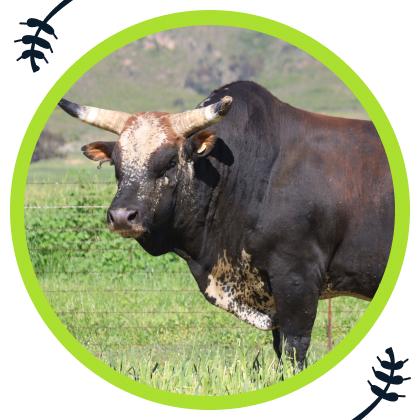
The selection for bulls to be part of the exceptional herd is just as strict; bull calves are only chosen from the first 25% of arriving calves. In addition, he must come from a cow with extreme fertility and very good milk production, and the bull calf must wean over 50% of his mother's body weight. After that, the bulls, like the cows, undergo a phenotypic inspection to determine the top 8% of bulls for that season. It is crucial that a bull displays a strong broad mouth, good width between the eyes with deep, protective eye sockets, and a very masculine head with good width between the horn attachments. From above, the shoulder should protrude, with good width between the shoulder blades where it attaches to the back - this is the one phenotypic trait of a bull that puts everything in place.
Bulls must also have a strong back with a good eye muscle, but the top-line doesn't have to be entirely flat. Non-negotiable is a beautiful rump with a slope of 12.5% or more, with a long and low tail attachment, as well as good jumping ability from the rib. For bulls to be selected, they must also have an average scrotum circumference of 35cm or more. There must be some visible buttocks on the bull, and he must not pull up too much in the flanks but must be wedge-shaped and heavier in the forelimb.
Those top 8% of bulls are then subjected to phase D growth tests, after which the results of those tests are used to form contemporary groups and compare bulls with their similarities. After the growth test, at 12 months, 35% of the selected bull calves that did not grow phenotypically and/or as desired, or showed poor weight gains, are summarily slaughtered. At 18 months, the remaining bulls are subjected to a stringent semen test, after which the top 5% are selected and retained for herd improvement, while the others are sold to commercial farmers at a production auction.
Important to remember when it comes to breeding is the words of Lochner Eksteen:
"There is no such thing as a perfect or best bull, but there is a perfect and best bull for your circumstances and needs. It is extremely important to apply bull selection based on the needs of your cow herd. Identify your herd's shortcomings and acquire a bull that can correct the problem."

As part of the breeding policy, it was decided to use variation in bulls in combinations. First-generation bulls must be late-maturing, large bulls with high growth potential. For the second generation, a flat, broad, and long bull is used to bring the calves back to a medium frame. For those calves, the third generation, a medium to large frame bull that is well-balanced and comes from a strong inherited milk and fertility line is used, after which the process starts again. Over the years, this combination has produced the best bulls and cows. For the breeding season, cows are divided into approximately 14 herds ranging from 35 cows to 11 O cows, and single bull matings are done. Only cows that are 15 years or older are artificially inseminated with seed from good bulls that are no longer alive or with seed from current bulls for targeted corrective matings. Older cows have already been proven by the system and have successfully weaned 14 or more calves, making the chance of getting a desired calf from such breeding almost a given.
However, AI (artificial insemination) calves are held to the same standards as other calves and do not benefit from their AI origin. The Exsteen Nguni herd welcomes calves from between 11 and 24 different bulls each year. Larger herds are mated with bulls whose daughters have already been bred in a desirable way and have reproduced well in the herd. Unproven bulls are paired with smaller herds and will only be phased out when their daughters pass the test. Each year, the bulls with the most daughters that did not conceive are sent to slaughter. Breeding cattle requires much more than just increasing your herd's numbers; through breeding, the farmer achieves deliberate and noticeable progress in the herd through planned matings. In the Exsteen herd, we evaluate weaned calves annually to determine whether the bull that would likely be the best match for a certain cow is indeed the best to mate with her. It is also important to see whether a weaker calf is the cause of a cow that produces poorly or whether it is the bull that does not complement her. You determine this by comparing the cow's production year after year.
The Eksteens aim to breed their own bulls whenever possible, but will purchase bulls that meet their standards, have been tested, and fit their reference framework. This all depends on the availability of animals. Purchased bulls will initially have smaller herds until their offspring prove themselves. The Nguni cattle breed has consistently proven itself as a high-performing and resilient breed. After the Eksteens replaced their crossbreed cows with Ngunis, the carrying capacity of the farm increased from 7ha/LLU to 1 ha/LLU, with minimal or no supplementation, consisting only of corn straw and protein lick if necessary.

Even in their driest year between 2003 and 2004, the cows had a 90% conception rate simply by grazing the field. Despite an average rainfall of only 175mm during the growing season from 2015 until now, there is no observed decrease in fertility among the Ng uni cows, and calves are not weaning any lighter. Exsteen Ngunis have also received numerous awards and prizes in addition to their excellent performances. In 2021 and again in 2022, they were one of only 10 herds of all breeds nationwide nominated for the "SA Studbook Platinum Award". In the past six years, they have won the "SA Studbook Platinum Award" for best cow of the year five times, as well as the LNR's "Cow of the Year" award four times. They are also one of the finalists for the LNR's herd of the year competition, in which only 1 0 herds nationwide qualify. With this winning recipe, the outlook for Exsteen Ngunis is promising and the future is wide open; they were able to learn from their mistakes over the years and improve each time to create an animal that performs ideally in given circumstances.

"You make a huge mistake if you only look at what consumers want and chase popularity curves, and I learned that the hard way. You are your own single biggest consumer and client, so you must breed an animal that will produce and reproduce the best for you in your unique circumstances"
- Lochner Exsteen.


