


THE JACKAL: A POTENTIAL DEFINITIVE HOST OF NEOSPORA CANINUM
Neosporosis is an infectious disease caused by the protozoan parasite

Neosporosis is an infectious disease caused by the protozoan parasite Neospora caninum¹²³.
This microscopic, unicellular parasite can invade, live, and multiply inside animal cells³. The disease affects cattle and companion animals and is one of the most frequently diagnosed infectious causes of abortion in cattle worldwide¹³. It can also affect dogs, leading to conditions such as gradually progressive myositis with paraparesis¹².
Neospora caninum was first reported in 1925. Initially, it was thought to be a type of Isospora bigemina, with cattle as an intermediate host responsible for vertical transmission and dogs as the definitive host responsible for horizontal transmission. The parasite was officially recognized and named as a new species in 1988. Prior to this recognition, infections of N. caninum were often misidentified as an infection of Toxoplasma gondii. Interestingly, twelve years before the recognition of N. caninum, Hammondia heydori was recognized.
Its oocysts are morphologically similar to those of N. caninum, leading to speculation that research performed on H. heydori prior to 1988 could have been conducted on N. caninum. N. caninum and T. gondii differ in their definitive hosts and primary infection targets. T. gondii primarily infects humans, felids, and sheep with felids as a definitive host, while N. caninum often infects cattle and dogs with canines being the definitive host.
Impact on Agriculture
Neosporosis is considered one of the most serious emerging diseases affecting cattle and dogs worldwide. It has also been reported in sheep, horses, and various wildlife species. The disease leads to abortion in cattle due to the vertical transmission of the parasite. This parasite is expected to be identified anywhere on earth where cattle are found, posing a major economic threat to any cattle-producing country due to severe losses associated with abortions.
Lifecycle and Biology
The life cycle of N. caninum comprises three infectious stages: tachyzoites, tissue cysts, and oocysts. It involves two modes of reproduction: sexual reproduction in the definitive host (including the oocyst stage) and asexual reproduction in the intermediate host (including the tachyzoites and tissue cyst stages).
The life cycle begins when un-sporulated oocysts are shed from infected canids through their feces. These robust oocysts can withstand freezing and drying of the feces, enabling them to survive outside the
host for prolonged periods. After sporulation occurs outside the host, each oocyst contains two sporocysts that each contain four sporozoites.
The next stage occurs when an intermediate host like cattle ingests the sporulated oocysts through fecal-contaminated water sources or pastures. The sporozoites are then liberated from the oocyst in the gut of the animal through excystation and travel into the gut wall where they develop into tachyzoites. These tachyzoites replicate rapidly over a period of three weeks.
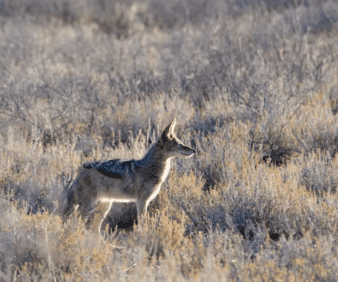
Given that other members of the Canidae family have been identified as definitive hosts for N. caninum, it is plausible that jackals could also serve this role. Jackals share habitats with many livestock species worldwide and could potentially contribute to the spread of N. caninum if they are indeed definitive hosts.
Understanding whether jackals are definitive hosts for N. caninum could have significant implications for controlling its spread and mitigating its impact on livestock industries worldwide.
As previously stated, cattle and other warm-blooded animals are seen as the intermediate host for this parasite, and dogs are seen as the definitive host. However, other wild canids including the coyote, grey wolf, and dingo have been identified as also being a definitive host for N. caninum.
Therefore, it is believed that the jackal can also play a role as a definitive host of N. caninum. While more research is needed to confirm whether jackals are definitive hosts for Neospora caninum, considering this possibility is crucial for developing effective strategies for managing neosporosis in livestock populations.
Source: Conversation with Bing, 9/26/2023
(1) Neosporosis in Animals - Merck Veterinary Manual. https://www.merckvetmanual.com/generalized-conditions/neosporosis/neosporosis-in-animals.
(2) Parasitic Infection (Neosporosis) in Dogs | PetMD. https://www.petmd.com/dog/conditions/infectious-parasitic/c_dg_neosporosis.
(3) Neosporosis | Moredun. https://moredun.org.uk/research/diseases/neosporosis.


