


Fuel relief offers a breather, but harvest-season pressures remain for SA farmers
7 min read|

A sector under pressure
South African agriculture is entering a critical phase under mounting pressure from rising input costs, volatile global markets and tightening profit margins. Fuel prices have surged sharply, fertiliser remains expensive, and farmers are increasingly forced to operate in an environment shaped not only by weather and yields, but by global geopolitics.
The recent conflict in the Middle East has played a major role in driving uncertainty. While a ceasefire announcement has temporarily improved global market sentiment, it has not eased the cost pressures already imposed in South Africa’s economy. Instead, farmers now find themselves navigating a fragile and uncertain landscape where input costs remain high, and margins are under strain.
Harvest season arrives at the worst possible time.
The timing of these cost pressures could not be more challenging. South Africa is moving into the peak harvest period for summer crops such as maize, soybeans and sunflowers, while winter crop planting is approaching.
This is one of the most input-intensive periods in the agricultural calendar. Diesel consumption rises significantly during harvesting as combines, tractors, irrigation systems and transport fleets operate at full capacity. At the same time, farmers must begin planning for the next production cycle, which requires upfront spending on fertiliser, seed and chemicals.
In short, farmers are facing rising costs at the exact moment when they need to spend the most.
The April fuel shock and levy relief
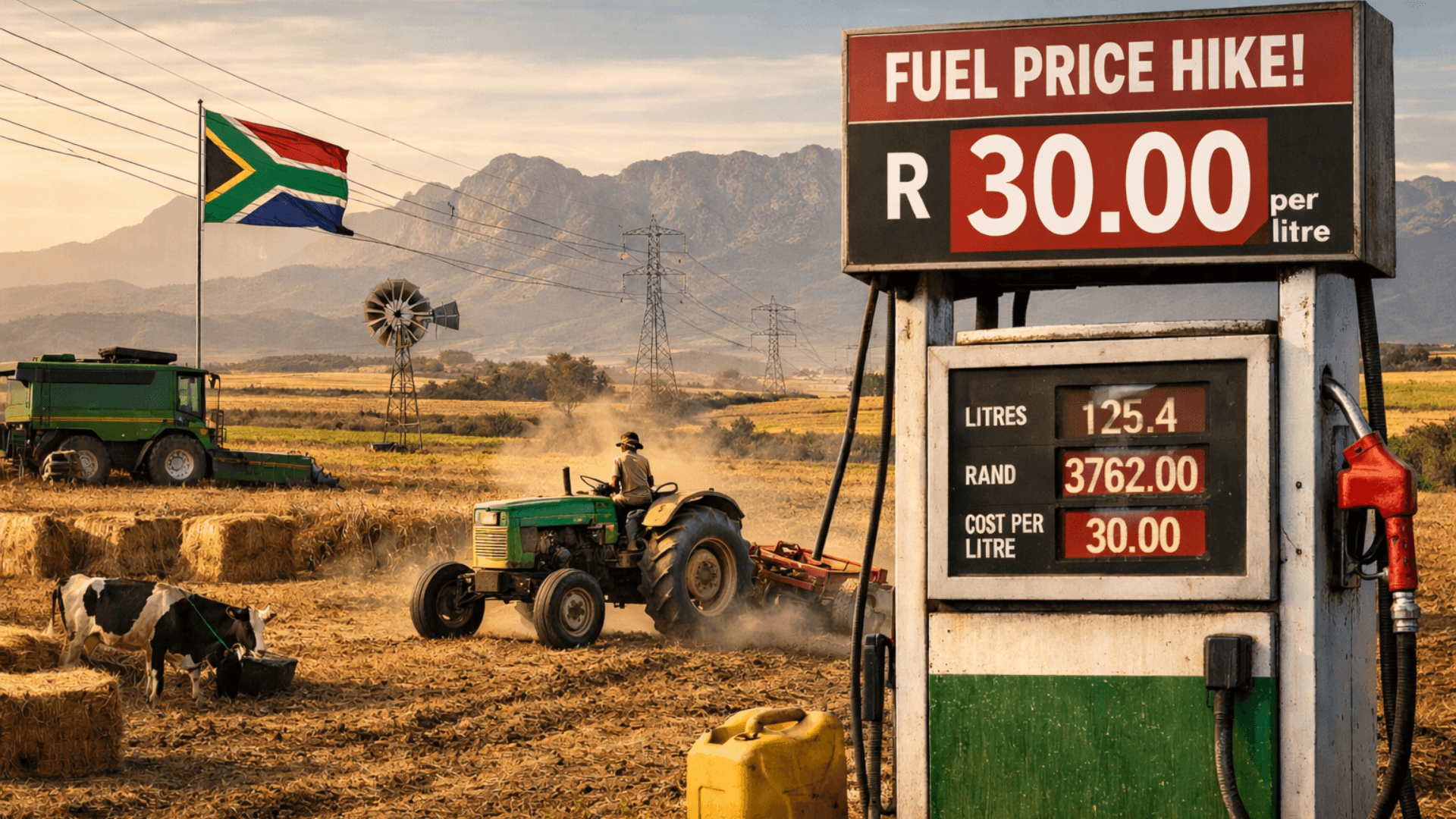
On 1 April, South African farmers were hit with a major fuel price increase. Diesel rose by R7.37/l and R7.51/l for the two grades, while petrol increased by R3.06/l. This pushed diesel prices above R25/l, significantly increasing operational costs across the agricultural sector.
However, the government intervened by reducing the fuel levy by R3/l, effective from 1 April to 5 May 2026. This measure softened what would have been an even more severe price shock and provided short-term relief to farmers and the broader economy.
While this intervention is welcome, it does not eliminate the problem. The increase still represents a substantial rise in input costs, and the levy cut is temporary. Once it expires, farmers could face renewed pressure depending on global oil prices and exchange rate movements.
Why fuel matters so much in agriculture
Fuel is not just another cost item in farming — it is a core input that affects almost every stage of production.
In the grain and oilseeds sector, diesel accounts for roughly 13% of input costs. It powers machinery used in planting and harvesting, supports irrigation, and drives transport logistics across the value chain.
Fuel is also central to moving goods. It transports fertiliser to farms, crops to silos, fruit to packhouses and food to retail markets. When fuel prices rise sharply, the impact spreads beyond the farm gate, affecting the entire agricultural system.
This means that even with the levy relief, the April fuel increase will still be felt throughout the harvesting season.

The ceasefire: relief, but not certainty
The ceasefire in Iran has introduced a degree of optimism into global markets. Oil prices will initially ease as fears of prolonged disruptions to key shipping routes, such as the Strait of Hormuz, subside.
For agriculture, this matters because lower oil prices could eventually reduce the cost of diesel, fertiliser production and logistics. If the ceasefire holds and shipping routes stabilise, input markets may begin to calm.
However, this relief remains uncertain. The ceasefire is widely viewed as temporary, and trade and shipping conditions have not yet returned to normal. Markets remain sensitive to any signs of renewed conflict.
For South African farmers, the key issue is timing. Even if global oil prices decline, the benefits will not be immediate. South Africa adjusts fuel prices monthly, meaning any sustained easing in global markets would only filter through over time.
In practical terms, the ceasefire offers hope — but not immediate relief.
Fertiliser: the bigger long-term risk
While fuel prices dominate headlines, fertiliser represents an even greater long-term risk for South African agriculture.
The country relies heavily on imported fertiliser and raw materials, making it vulnerable to global price movements, exchange rate fluctuations and shipping disruptions. This dependence exposes farmers to risks beyond their control.
The Middle East plays a significant role in global fertiliser supply, particularly for products such as urea and sulphur-based inputs. Instability in the region can therefore directly affect fertiliser availability and pricing.
Even if oil prices stabilise, fertiliser costs may remain elevated due to knock-on effects and ongoing supply chain disruptions. This creates a double burden for farmers: rising fuel costs in the short term and sustained pressure on fertiliser in the medium term.
Margins under pressure
While input costs are rising, commodity prices are not providing sufficient support. Farmers are price takers, meaning they have limited ability to bargain for higher prices for their products. In many cases, domestic and global supply conditions are keeping agricultural prices subdued.
For example, maize prices in March 2026 declined significantly year-on-year, with white maize down 41% and yellow maize down 28%. This weak price environment makes it difficult for farmers to absorb rising input costs.
The result is a classic margin squeeze: higher costs on one side and stagnant or declining prices on the other.
Difficult decisions ahead
Faced with this, farmers may be forced to make tough operational decisions. This could include delaying fertiliser purchases, reducing application rates, scaling back planted areas, or managing cash flow more conservatively. While such strategies may help protect short-term finances, they can also have negative consequences.
Reduced input use can lower yield potential, while smaller planted areas can limit production volumes. Over time, this can weaken profitability and increase financial risk.
The challenge is that these decisions must often be made before global conditions stabilise. Farmers cannot wait for geopolitical clarity — they must act based on current realities.
What South African farmers can expect
Looking ahead, several key themes are likely to shape the agricultural outlook:
- Continued cost pressure: Fuel and fertiliser costs are expected to remain elevated in the near term, particularly if global uncertainty persists.
- Volatility rather than stability: Markets are likely to remain sensitive to geopolitical developments, meaning price swings could continue.
- Delayed relief from global markets: Even if oil prices ease, the benefits will take time to filter through to local fuel prices.
- Tight margins during harvest: Farmers will face higher harvesting and logistics costs, with limited ability to offset them through higher commodity prices.
- Ongoing fertiliser risk: Input decisions for the next planting season will remain uncertain, especially if supply chain disruptions continue.
Implications beyond the farm gate
The impact of rising input costs is not confined to farmers. Higher fuel and logistics costs will likely filter through the agricultural value chain, affecting processors, retailers and ultimately consumers.
While farmers cannot fully pass on costs, increased distribution and handling expenses may still lead to higher food prices over time.
This highlights the broader economic importance of agriculture and the need for stability in input markets.
A breather, not a recovery
The temporary fuel levy cut provides important short-term relief and prevents an even more severe shock to the agricultural sector. The ceasefire offers a potential pathway to calmer markets.
But neither development represents a full solution.
South African agriculture remains structurally exposed to imported fuel, imported fertiliser and global logistics disruptions. Cost increases already affect the system and will continue to affect farmers through the harvest season and into the next production cycle.
For now, the outlook is clear: farmers can expect a period of tight margins, cautious spending and continued uncertainty.


