


Predictive maintenance for long-term machine use
5 min read|

Tips for the long-term protection of agricultural machinery
Predictive maintenance results in long-term use
Agricultural machinery and equipment are in demand year-round. This also means that they are exposed to different weather conditions and types of soiling. While heavy soiling is caused by tillage and spring sowing, fertilisation and harvesting leave traces on the vehicle in autumn. Cold, wet conditions in the winter months can then attack paintwork and surfaces, causing long-term damage. Thorough cleaning and preservation are crucial for extending the service life of the technology and avoiding expensive spring repairs.
The intensive use of agricultural machinery, whether for tillage, sowing, maintenance or harvesting, leads to heavy contamination from soil, plant residues, oils and greases. These residues can accumulate over the winter months, leading to corrosion and material fatigue. Inadequate cleaning and a lack of protection age the machines, reduce their resale value, and, in the worst case, can lead to breakdowns in the next season. Particularly in agriculture, where reliability and efficiency are of the utmost importance, predictive maintenance is therefore essential.
Preparation and cab maintenance
Before removing stubborn dirt from the paintwork and surfaces, the cab should be cleaned. Even here, it is possible to prevent dirt particles and other contaminants from settling. A wet-and-dry vacuum cleaner removes dust and dirt, keeping the interior clean. The cab windows should also be cleaned from the inside. This not only ensures a hygienic and pleasant working environment but also improves operational and road safety, and helps preserve the vehicle's value.
Removing heavy soiling with high-pressure hot water
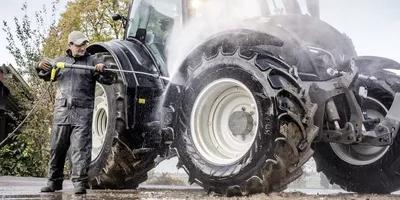
The use of high-pressure cleaners has proven its worth in preparing agricultural vehicles for the challenging working conditions. When used with alkaline detergents, the best results can be achieved here, and stubborn dirt can be effectively removed. To do this, the vehicle should first be thoroughly wetted with a high-pressure cleaner and enough water to soak up and dissolve the dirt. The detergent is then applied to the vehicle from the bottom up using a cup foam lance.
Heavily soiled areas on the vehicle can also be mechanically cleaned with a wash brush for better results. After the foam has taken effect, it can be rinsed off with high pressure. A constant spray distance of 20–30 cm yields good results. The correct angle depends on the selected nozzle. With the eco, the booster, or the 40° nozzle, an angle of well over 25° is selected to achieve the same spraying distance. Hot water machines are particularly efficient here, as the temperature significantly increases the cleaning performance and better dissolves greases, oils, organic contaminants such as fermentation residues or slurry, as well as mineral contaminants such as dusty and granular fertiliser residues or residues of plant protection products. This enables even stubborn dirt to be removed thoroughly. The water flow rate is more important than the pressure – a 1000-litre machine saves 60% of cleaning time compared to a 500-litre machine. Various accessories, such as an LED nozzle light for poor visibility and longer lances or articulated joints for cleaning large and tall machines, make work easier.
Conservation wax provides surface protection.
After intensive cleaning, applying a conservation wax, ideally in spray form, is the crucial step for long-term protection. This wax forms a protective layer on the paintwork and other surfaces, preventing moisture and dirt from penetrating over the winter months. The application is extremely simple and efficient: After thorough cleaning, the hot wax is applied to the surface from bottom to top using a cup foam lance, a detergent injector, or a spray unit. The optimal application temperature is between 40 °C and 80 °C, but the wax can also be processed effectively with cold water. The treated surface is then rinsed from top to bottom. The hot wax is extremely economical and efficient: Even a low dosage of 0.25-0.5 per cent is sufficient to achieve very good results and ensure reliable surface protection.
The particular advantage of hot wax lies in its ability to form a robust, durable protective layer that not only protects against corrosion but also makes it more difficult for new dirt to adhere in the spring. This reduces the cleaning effort and also helps to keep the machines looking in really good condition. This not only preserves the value of the expensive agricultural technology but also ensures operational safety for the coming season.
Checking fluids and finding a protected parking location
Once cleaning and preservation are complete, additional precautions can be taken to protect agricultural machinery and equipment from cold temperatures. This includes ensuring there is sufficient antifreeze in the coolant and windscreen washer system and topping up or changing it if necessary. For diesel engines, winter diesel should be used, and the engine should be allowed to run briefly after refuelling to ensure it is distributed through the filters and pumps. Oil levels should also be checked and topped up if necessary. Ideally, agricultural machinery should be stored in a dry, well-ventilated, protected shelter to protect it from weather such as rain, snow, and frost.
Step by Step Cleaning Prosedure

Soiling should be removed using a wet-and-dry vacuum cleaner to prevent it from settling in the cab.

The intensive use of agricultural machinery leads to heavy contamination from soil, plant residues, oils and greases.

Detergents can be applied using cup foam lances. The foam is effective and efficiently dissolves dirt on vehicles.

With the right model, you can switch between a high-pressure jet and foam at the touch of a button without changing the spray lance.
Hot water machines enable even stubborn dirt to be removed thoroughly.


