


South Africa feels the heat as the US-Iran conflict tightens the global fertiliser squeeze
6 min read|
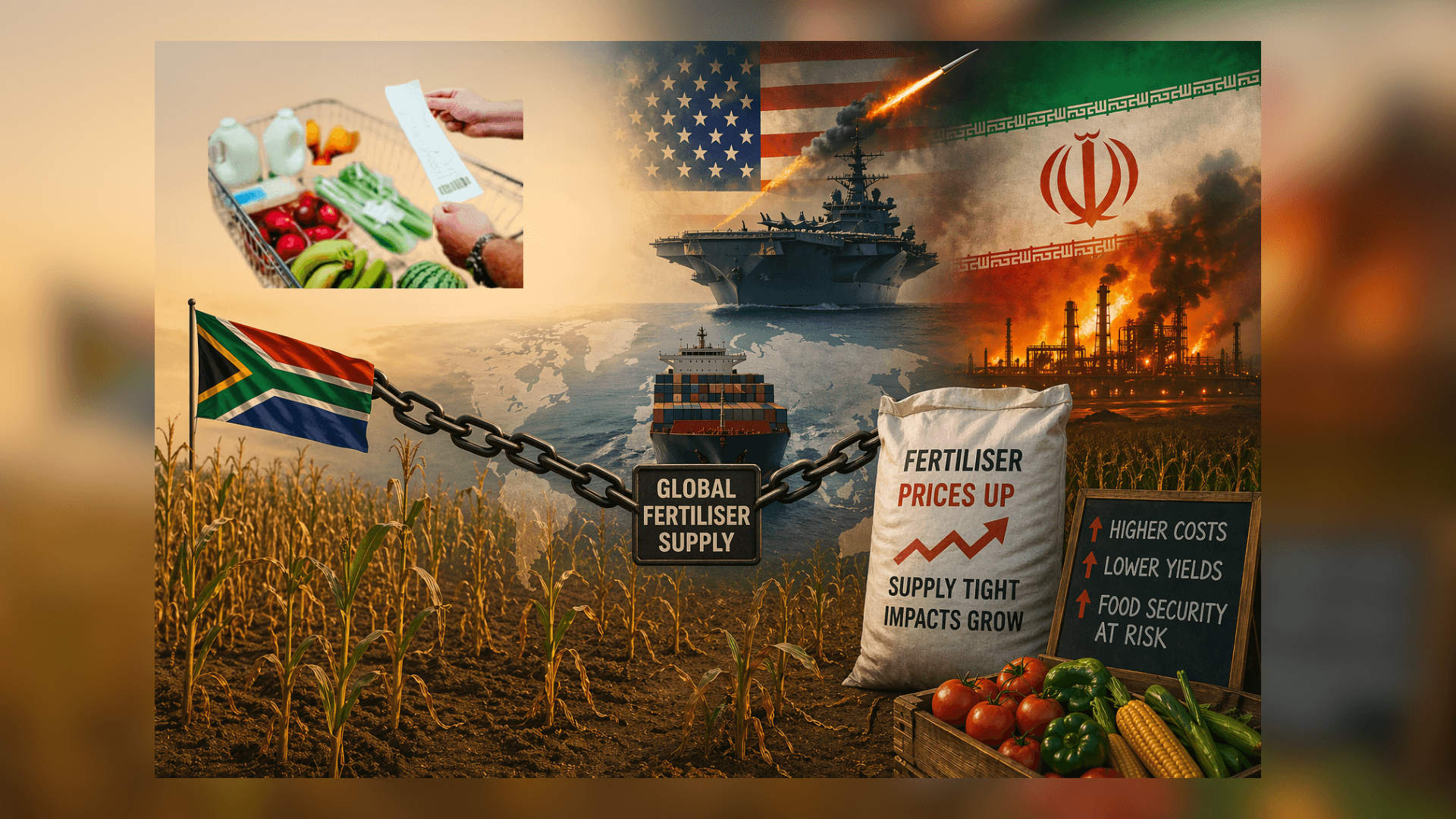

A war far away, a shock close to home
The war may be unfolding far from South Africa’s farms, but its effects are impacting one of agriculture’s most sensitive supply chains. For fertiliser and animal feed companies, the US-Iran conflict has emphasised a familiar reality: fertiliser is not only a farm input, but a geopolitical commodity. When conflict disrupts markets, shipping routes and globally traded nutrients, the consequences do not stay in the Middle East. They show up in higher costs, delayed cargoes and harder choices for South African producers.
The Gulf remains central to world trade, especially for oil and fertilisers. At the same time, the Strait of Hormuz is a key corridor for gas and agricultural commodities, making any disruption there immediately relevant to production costs.
Why the conflict matters to fertiliser
Recent reports show directly how the wider businesses have been affected. Animal feed companies have also made clear that the knock-on effect of the conflict in the Middle East would depend on global demand in commodity markets for products such as oil, gas, nitrogen, urea, and phosphates.
This is important because natural gas is the key feedstock for ammonia, which, in turn, is the building block of nitrogen fertilisers. If gas becomes scarce or more expensive, fertiliser production costs climb quickly. If ships are delayed or rerouted through riskier waters, transport costs rise as well. In short, even businesses far from the conflict zone can feel the pressure when the global nutrient system tightens.
Fertiliser and feed are part of the same story.
This is not only a fertiliser story. It is also an animal-feed story. South Africa is active not just in crop nutrition, but also in animal nutrition. That makes the current disruption more significant because some of the companies sits at an intersection of plant production and livestock production.
Animal feed production depends on more than maize, wheat or silage. It also depends on mineral supplementation, especially phosphorus. Phosphorus plays a critical role in animal health, bone development, fertility and feed efficiency. Without adequate mineral inclusion, feed quality suffers and animal performance drops.
That is where the Middle East becomes relevant beyond fertiliser. The region and its wider neighbours are important players in the global phosphate economy. Phosphate rocks and related phosphate products are essential not only for fertiliser production, but also for feed phosphates and mineral premixes used in livestock rations.

Why Middle Eastern minerals matter to animal feed
For South African farmers, this is an important but often overlooked link. Poultry, dairy, feedlot, and sheep operations depend on balanced rations that include mineral inputs, such as phosphates, for feed mixes. These are not optional extras. They are essential to animal performance, skeletal strength, growth and production.
The Middle Eastern conflict contributes to tighter phosphate markets, higher freight rates, and uncertain supply; the cost of those mineral inputs can rise. That makes feed production more expensive, even before grain prices are factored in. In a country where feed costs already dominate livestock margins, that can have serious consequences.
The knock-on effect for South African farmers
The knock-on effect for South African farmers is significant. Arable producers face higher fertiliser costs, which increase the cost of producing maize, wheat, and oilseeds, as well as preparing pastures. At the same time, livestock producers face higher feed costs as mineral ingredients become harder to source or more expensive to include.
That creates a layered cost squeeze across the agricultural economy. Grain farmers pay more to produce feed crops. Feed manufacturers pay more to formulate balanced rations. Livestock farmers then pay more for feed, mineral licks and production supplements. By the time the impact reaches the farm gate, it is no longer just a fertiliser problem. It has become an input problem.
For poultry producers, this could mean tighter margins in a sector where feed is the highest single cost. For dairy farmers, it could mean higher costs per litre of milk produced. For feedlot operators, it could mean more expensive finishing rations and thinner returns. And for mixed farmers, it can mean being hit from both directions at once: higher crop input costs and higher livestock feed costs.
A squeeze that reaches the farm gate
For South African agriculture, then, the danger is not necessarily one dramatic shutdown. It is a grinding squeeze across multiple inputs. Cargoes become less predictable. Input budgets become harder to manage. Farmers delay decisions. Nutrient strategies are trimmed back. Feed manufacturers monitor mineral and raw material markets more closely. Livestock producers recalculate margins.
The pressure may appear subtle at first, but over time it can build into lower output, weaker profitability and higher food prices. What begins as a geopolitical disruption to gas, shipping, and mineral supplies can quickly become a farm-budget problem in the Free State, Mpumalanga, or the Eastern Cape.
That is why a war far beyond South Africa’s borders can still influence decisions in a maize field, a broiler house, a dairy unit or a feedlot. Fertiliser and feed are often discussed separately, but in moments like this, they are part of the same story: a global supply system under strain, with local farmers left to absorb the shock.
The bigger picture
The clearest way to frame the South Africa story is this: fertiliser and animal feed companies are struggling because of the global system on which their businesses depends has become more unstable.
And once that system comes under pressure, the consequences do not stop at fertiliser. They spill over into feed production, mineral supplementation, livestock margins and ultimately the cost of food itself. For South African farmers, that means the US-Iran conflict is not a distant geopolitical event.
It is a growing input-cost threat with real consequences across the entire agricultural chain.


