


Kevin Kalb at Grain SA Congress: Soil health only matters if it pays
9 min read|
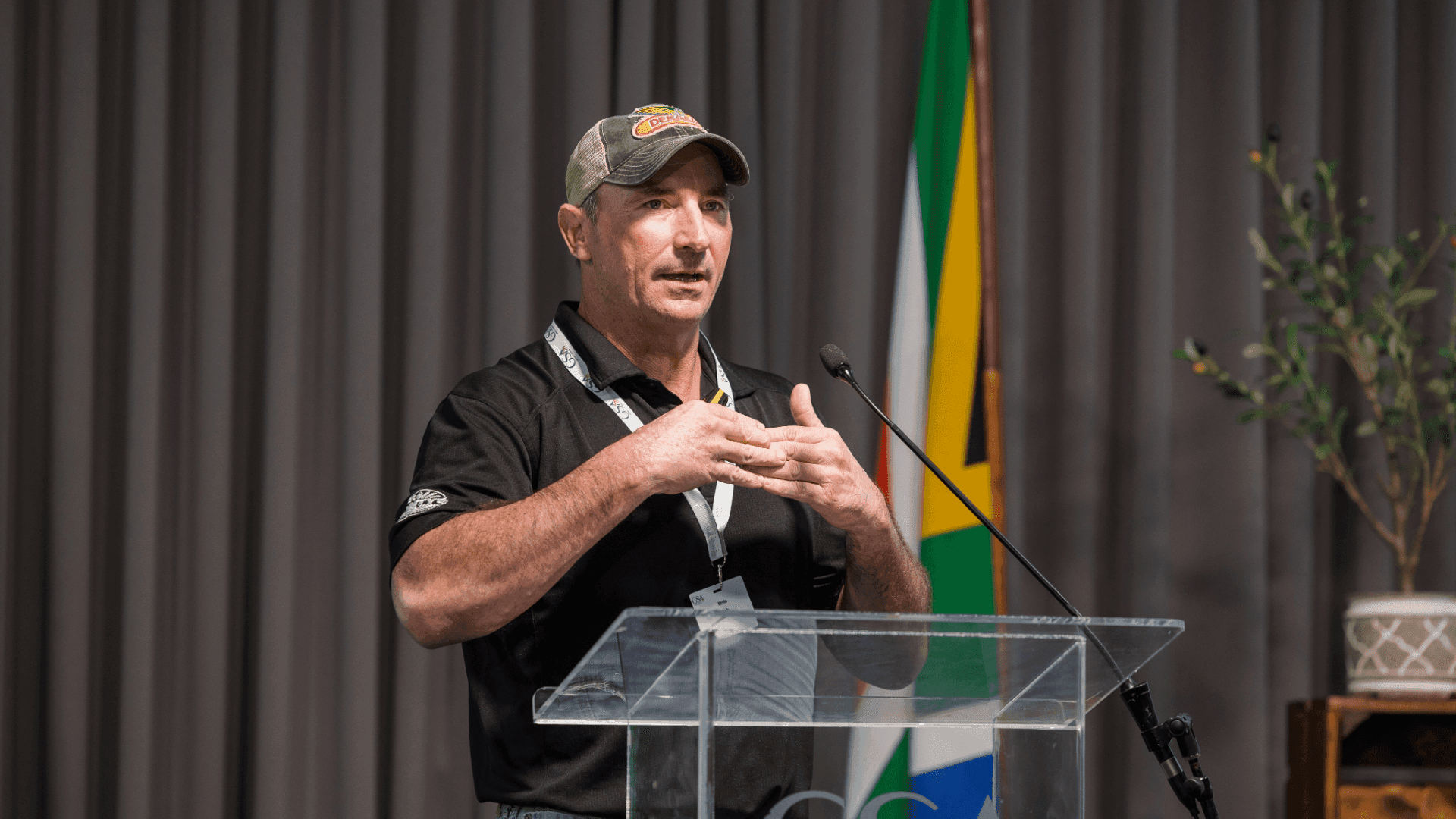

When American grain producer Kevin Kalb took the stage at the 2026 Grain SA Congress, his message was simple and sharp: soil health is not something farmers should pursue because it sounds good in theory. It only matters if it improves efficiency, sharpens decisions and adds to profit at the end of the season. In a time of expensive fertiliser, volatile weather and tight margins, that is exactly the kind of message producers want to hear.
Why farmers listened
Kalb’s credibility does not come from being a polished speaker or a researcher with a slide pack. It comes from production. Over several years, he has built a reputation in the United States as a top-performing maize producer, repeatedly placing first in the National Corn Growers Association yield contest. In farming circles, that matters. Contest results are public, competitive and difficult to fake. They tell other producers that this is someone who has pushed yield ceilings in real fields, not just talked about potential from behind a desk.
But what makes his message significant is that he does not sound like a “soil health evangelist”. He talks like a high-performance farmer who wants a return on investment. His message has been consistent: stop guessing and start measuring. He has repeatedly said that he bases his decisions on analysis and field data rather than assumptions or habit. That changes the whole soil health discussion. It stops being about ideals and becomes about management. For a commercial grain farmer, that is a far more useful place to start.
The real issue: getting more from every input
One of Kalb’s strongest themes was the idea that modern farming has an efficiency problem. Over time, fertiliser use has climbed, especially nitrogen use, but returns do not always rise with it. Farmers often respond to pressure by pushing harder on inputs, yet that does not automatically mean those inputs are working harder for the business.
That point lands hard in South Africa. Producers are farming in an environment where input bills are heavy, break-even levels are high, and there is very little room for waste. Every extra litre, kilogram or pass must justify itself. Kalb’s argument was not anti-fertiliser. He was not saying producers should cut back. His point was much more practical: if money is going into the soil, a farmer needs to know how much of that investment ends up in the crop and drives a profitable response.
That makes the conversation less emotional and more disciplined. The question is no longer, “How much should I apply?” The real question is, “How much of what I apply is actually paying?” That is a very different mindset, and it forces farmers to consider timing, placement, source, soil conditions, and uptake efficiency as part of the same margin discussion.
Nitrogen losses are where margins disappear.
Kalb also put nitrogen efficiency under the spotlight, and for good reason. Nitrogen is often one of the highest and most volatile costs in a grain budget, yet a surprisingly large share of applied N can be lost before the crop fully uses it. Depending on conditions, it can disappear through volatilisation, leaching, delayed conversion or other pathways that quietly erode return on investment.
That is where a lot of margin disappears without farmers always seeing it clearly. A producer may look at the total nitrogen bill and assume the crop received the full benefit, but that is often not the case. Kalb’s message was that better nitrogen management is not only an agronomic issue; it is a profit issue. More nitrogen is not always the answer. In many cases, the answer is to improve the percentage of the plant that uses it.
This is where tighter management starts to matter. Better placement, smarter timing, more accurate rates and proper crop monitoring help to reduce the gap between what is applied and what is used. For farmers trying to protect margins, that shift is powerful. It turns nutrient management from a routine task into a strategic advantage.

Why did he challenge old ways of measuring soil health?
One of the more provocative parts of Kalb’s presentation was his challenge to common soil health measurements. He argued that some of the metrics farmers have traditionally leaned on, especially total organic matter, can be too blunt and too slow-moving to guide practical short-term decisions. In other words, they may describe the soil, but not always in a way that helps a producer make the next profitable move.
That does not mean organic matter is unimportant. It remains a key part of soil function and long-term resilience. But Kalb’s point was that farmers also need measurements that are more responsive and more closely linked to what is happening in the soil right now. He pointed to indicators such as active carbon or water-extractable carbon as more useful for showing biological activity and nutrient-related functions.
That matters because farmers are not managing soil for a laboratory report. They are managing it for cash flow, crop response and risk. A number is only valuable if it helps answer a question: does this tell me something I can act on this season, on this field, with these input costs?
That is why Kalb’s challenge to old metrics is worth paying attention to. He is not rejecting soil testing. He is pushing for better testing that supports better decisions.
Moving away from blanket fertiliser thinking
Another strong message from Kalb was that fertiliser decisions should not be based on habit or blanket recipes. They should be built around probability. Instead of asking whether phosphorus or potassium can improve yield somewhere, the smarter question is whether that application is likely to pay on your farm, in your soil category, at your current grain and fertiliser prices.
That is a major shift, and it can save producers a lot of money. Too often, fertiliser programmes are repeated because they are familiar or because they worked once under different conditions. But profitable farming is not about doing what usually sounds safe. It is about understanding where a response is most likely and where a spend is least likely to return.
This is where soil tests, tissue tests, historical records and on-farm strip trials become so valuable. They help farmers move away from broad assumptions toward decisions based on local evidence. Not every hectare has the same probability of response. Not every deficiency is equally urgent. Not every “yield-building” input is worth the cash outlay. Kalb’s message is that risk must be part of the fertility discussion, not something farmers only think about after the cheque is written.
So, does soil health pay?
The honest answer is yes — but not automatically, and not in the same way everywhere. That is probably the most important point in the whole discussion. Soil health is not a guaranteed payout. It is not something that delivers the same result on every farm, in every season or under every management system.
Practices linked to soil health, such as cover crops, reduced tillage, residue retention and a more balanced biological function, can strengthen a production system over time. They can improve infiltration, nutrient cycling, structure and resilience. But the economics are often more complex than the slogans suggest. Some practices need time before they show value. Some carry upfront costs. Some only work properly when combined with livestock, careful rotation planning or lower machinery disturbance.
That is why Kalb’s message is more credible than a blanket “soil health pays” promise. He did not argue that every practice is automatically profitable. He argued that measurable improvements in soil function can pay when they improve nutrient use efficiency and support better management decisions. That is a message rooted in discipline, not hype.
What this means for South African farmers
For South African producers, Kalb’s message cuts through a lot of noise. Local farmers are dealing with real pressures: variable rainfall, expensive fertiliser, high fuel costs, rising finance pressure and major regional differences in yield potential. Under those conditions, no farmer can afford to treat soil health like a fashionable checklist.
The reality in South Africa is that systems perform differently across areas, soil types, and management levels. A practice that improves margins in one maize district may create more risk in another. A conservation system that delivers strong results after several years in one region may still be unstable in another. That is why Kalb’s “measure first” approach is so useful. It forces farmers to test what works in their own environment rather than buying into broad promises.
That also gives the local soil health discussion more maturity. Instead of asking whether farmers should be “for” or “against” a certain practice, the better question becomes: under what conditions does this practice improve profit, and how do I prove it on my farm? That is a much stronger business lens.

Where the first gains usually come from
One of the most practical parts of Kalb’s message is that the first profitability gain usually does not come from a flashy new system. It comes from a better feedback loop. Before farmers invest in the next big intervention, there is often more money to be made by tightening how information is collected and used.
That means solid soil tests, regular plant and tissue analysis, accurate field records and proper on-farm comparisons. It means knowing which field responded, which did not, where nutrients were lost, where timing was wrong, and where the crop converted inputs into gains. Those are the details that make input decisions sharper and help prevent repeat mistakes.
This is also where many farmers can start without overhauling the whole business. Better measurement does not always mean more complexity. Sometimes it simply means being more honest about what is known, what is assumed and what still needs to be tested. That is the spirit of Kalb’s advice. He is not asking farmers to gamble on a concept. He is asking them to build a system that proves value.
The bottom line
Kevin Kalb did not come to Grain SA Congress to say that soil health always pays. His message was tougher, more practical and more useful than that. He showed that soil health is only valuable when it improves nutrient efficiency, strengthens management decisions, and increases the likelihood of a profitable outcome.
That is why his message matters. In the years ahead, the farms that stay competitive will probably not be the ones using the most inputs or chasing the latest buzzwords. They will be the ones measuring more accurately, wasting less, adapting faster and making better decisions under pressure.
That is where soil health stops being a slogan. That is where it starts becoming a business advantage.


